
The birth of a wildcat
From concept to completion
By Neil Schultz
Wildcat cartridges can basically be described as any that are not produced commercially. The process of developing a wildcat most commonly commences with a readily available factory cartridge. Those ‘parent’ cartridges are then ‘necked up’, ‘necked down’, shortened or otherwise modified to produce the desired result. ‘Wildcatting’ has been going on since the first smokeless powders were developed. The popularity of the pastime had its peak from the 1930s through to the late 1950s but is still practised by a small band of enthusiasts.
The reasons for individuals modifying a cartridge vary but are usually performance driven. This was certainly the case during the heyday with ‘improved’ versions of many factory offerings emerging from wildcatters’ sheds. Many cartridges that originated as wildcats from home workshops were adopted by major manufacturers to become industry standards. For example, the .270 Remington began as a .30-06 necked down to .277cal. Similarly, the renowned, flat-shooting .25-06 emerged via the same path of evolution from the parent .30-06. Necking the .30-06 up to .35cal produced the .35 Whelen. The .257 Roberts was a necked down 7mm Mauser cartridge. The Roberts later gave birth to the .220 Swift when necked down to fire .224 calibre bullets. Along similar lines, the .308 was simply necked down to produce offspring including the ever-popular .243 Win, the .260 Rem and the 7mm-08. Going in the opposite direction and necking the .308 up in diameter gave us the .338 Federal and the .358 Winchester, both commercially adopted cartridges.
My incentive for developing a wildcat was purely for sentimental reasons. Following the arrival of my first grandson, I thought it would be cool to have a cartridge named after him. I had a few criteria to meet: recoil had to be moderate enough for a youngster to handle comfortably; reloading costs needed to be manageable so that I didn’t hand a rifle on to the family that was too expensive to feed; and, most importantly, it had to be

an original concept. Lastly, it needed to be practical, as it’s intended use would be pest animal management up to and including fallow deer and feral pigs. So began the research phase.
Planning a wildcat begins with selecting the calibre to be used. I looked at .224 but found that it is so popular that almost every imaginable variant has already been tried. Thirty calibre was the top end of my possibilities, as I wanted something that the young fellow would find comfortable when he reaches the age at which he can shoot. Nothing I could devise in .30 calibre seemed practical. Likewise, with 6mm and 6.5mm due to their long-lived popularity with both wildcatters and industry ballisticians. After many hours of searching books and websites, I selected .277cal as the most likely candidate due to it not really finding favour with cartridge developers.
The next step was picking the parent case that would form the basis for the new cartridge. Any variation using the long action .30-06 would generate more than the desired recoil, so that was rejected. Every .308-based variant has already been tried and documented, and I needed something unique so that I had the naming rights. Even shortening the .308 case and necking it down to .270cal was rejected due to similarity in dimensions to the .277 Fury commercial cartridge.
A full-length .223-based wildcat already exists going by the cool name of the .277 Wolverine. Shortening the .223 case before necking it up a-la .300 Blackout would not give the velocities I was looking for to make the cartridge viable for medium game beyond short range. Following the same train of thought as choosing a calibre, I decided to go for something far removed from common use for a parent case. In a very fortunate coincidence, I just happened to have a rifle with a 7.62×39 Russian bolt face sitting little used in the safe. From all the reading and web surfing I did, nothing was found to suggest this cartridge had been used as a base for a .277cal wildcat. Game on!
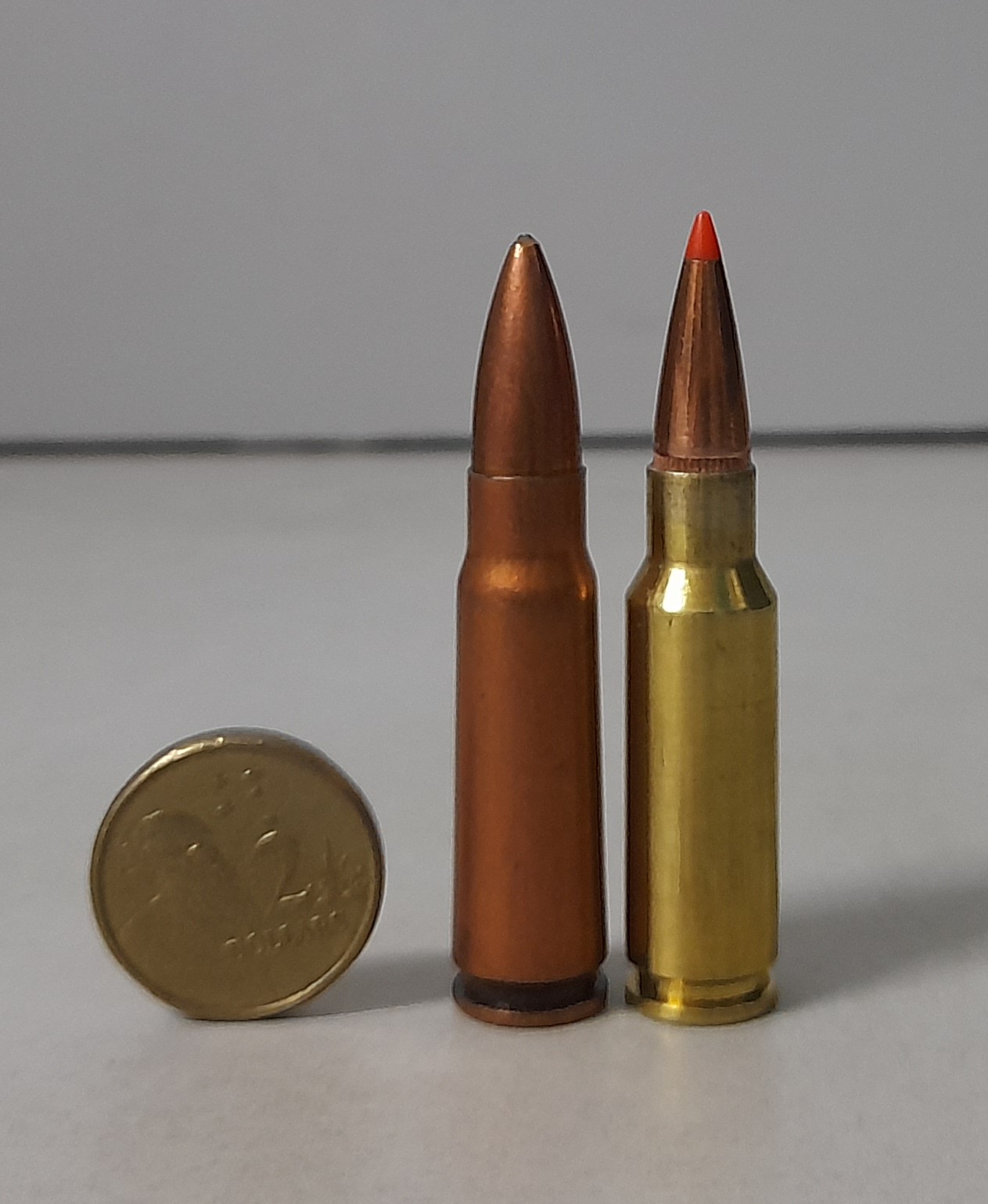
In order to keep the process as simple as possible, I decided to keep the overall case length unchanged. Shoulder to base measurement would be pushed back by .020” to give a slightly longer neck for loading modern, long ogive bullets. The shoulder angle was sharpened from the 17 degrees on the original Russian to a much sharper 30 degrees and most of the taper was removed from the body, bringing the diameter at the shoulder to 0.432”. These changes increased the powder capacity and followed modern case design parameters that increase efficiency in powder burn. The sharper shoulder angle also helps reduce case stretch, which decreases the frequency of case trimming and increases brass life.
Once my design was drawn, I contacted Jim at Buffalo Gunsmithing for his input into reaming the chamber. He came up with the answers for which I was hoping. The task could be done in a couple of steps with an existing reamer for a different cartridge for the chamber, then boring the throat and free-bore in a separate operation. I found a stainless .277cal barrel on the shelf at a nearby gun shop and had it delivered to the gunsmith along with my donor rifle.
As this was a totally new cartridge, there were obviously no reloading dies yet in existence. Making the brass required a little imagination and several steps. I started with once-fired 7.62×39 brass, kindly donated by a mate. Step one was pressing out the primers with a universal depriming die that I use for almost all of my reloading. Then the cases were run through my Ugly Annealer to make the necks more malleable. If this step is skipped, one risks splitting a lot of case necks when they are fire formed. Reducing the diameter of the necks required some backyard engineering on my part. I bought a sizing die for a .270 WSM to give enough clearance in case diameter and shoulder angle for the new cartridge’s specs. Due to the length of the die, I lopped 22mm from its body with a cut-off wheel. Forget the hacksaw; those die bodies are very hard! This left me with what is basically a universal, short .270 neck-sizing die. Lubing the case necks inside and out allowed them to be pushed from .341” to .305” outside diameter in one pass. I used this modified die with the expander ball and depriming pin removed so the only working of the brass in this step is squeezing the neck’s outside diameter and bumping the shoulder back by 0.02”. Precisely sizing the inside neck diameter to .276” was then achieved using a mandrel in a universal expander die.
All those preparation steps give a close approximation of the finished cartridge, except for the body taper and shoulder angle. This final change to the case’s shape is achieved by fire-forming, a common practice in wildcatting where the pressure generated by firing the round blows the case out to the chamber’s dimensions. The more brass is reshaped, the harder and more brittle it becomes. To reverse the hardening, I annealed the cases after each step and will continue to do that after each firing. Of course, fire forming can’t be undertaken without the finished rifle.
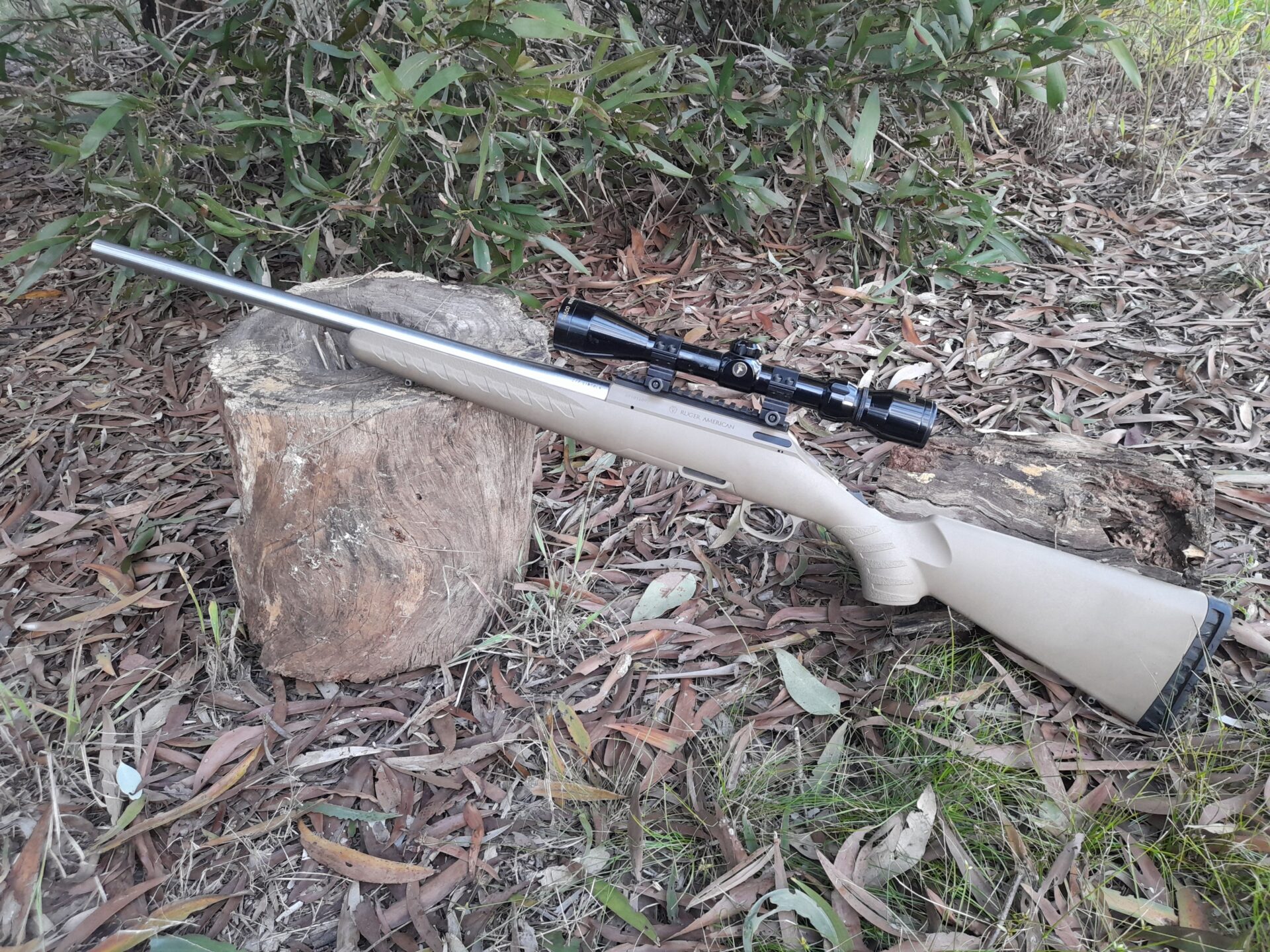
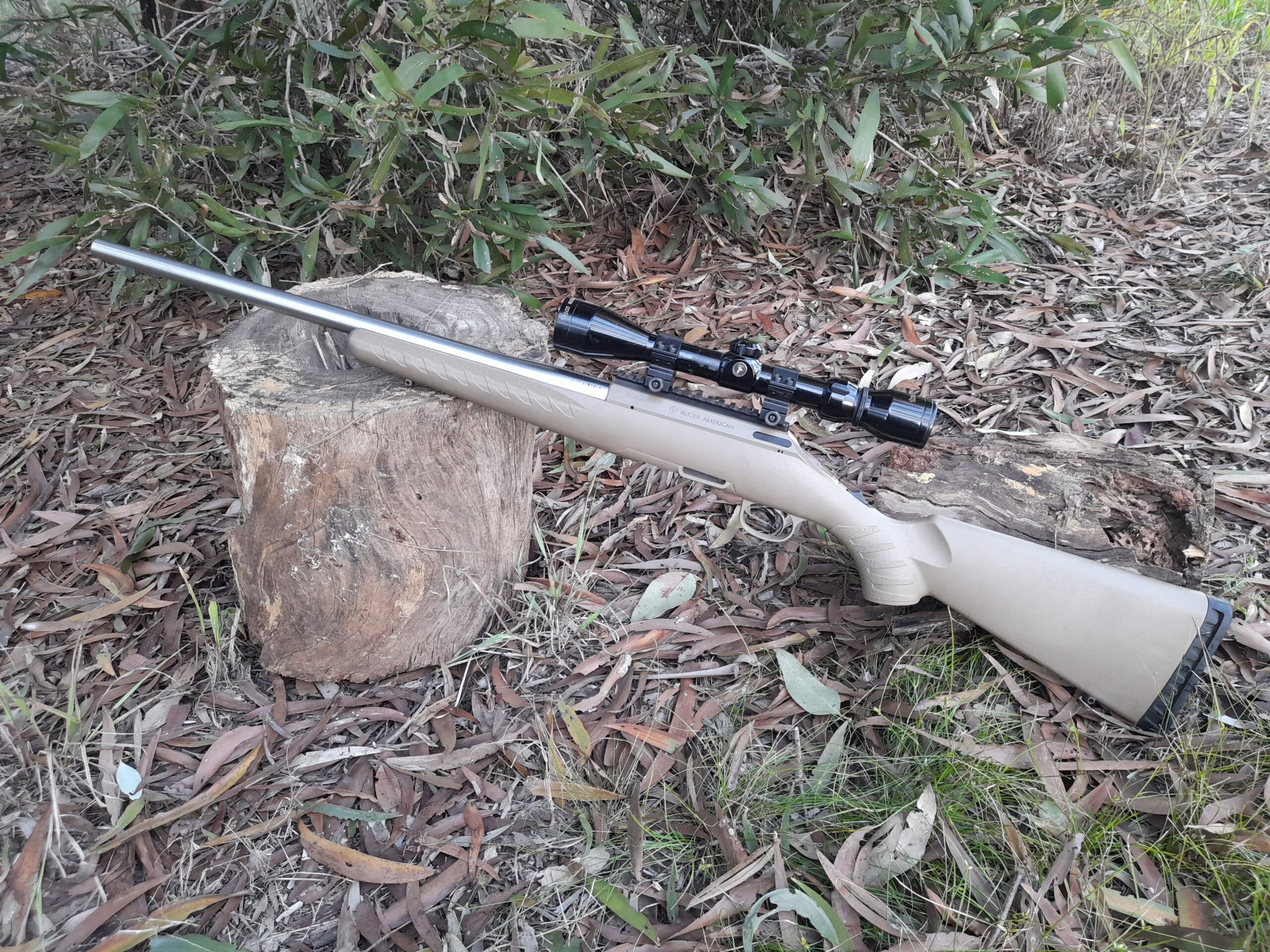
Buffalo Gunsmithing had the barrel chambered and fitted in quick time and I was impressed with the rifle’s shiny new stainless barrel. Very proudly engraved on the barrel is its official designation, the ‘.277 Lincoln’ – Lincoln being the Christian name of my new grandson!
A lightweight 3-9 scope was unearthed from the archives in my gun room and fitted, just to get some shots through the new rifle. The first trip to the range was undertaken to fire-form some cases and complete the initial barrel run-in process. Having some brass fully formed in my chamber allowed some load development to be undertaken. Initial loads were assembled using a fairly fast burning powder: ADI Benchmark 2, pushing 90-grain flat-based hollow-point projectiles. These very safe starting loads registered on the chronograph at an average muzzle velocity of 2,550fps. Grouping was quite acceptable for a new barrel, putting five shots into a 0.8” group at 100 metres from the bench. I’ve now settled on a load yielding 2,690fps after some load development. Later, three-shot groups were tighter after some fire lapping of the barrel.
As an experiment for shooting longer ranges, I also loaded test rounds with ADI 2206H and 130gr ballistic tipped bullets. These were disappointingly much slower at the muzzle, so I tested with the same powder used for the lighter projectiles. Another range session saw much better results, with the 130gr bullets leaving the barrel at 2,440fps delivering sub-half MOA groups.
Having successfully developed loads for the new outfit, it naturally needed to be field tested. A quick dash down to the granite highlands of the southern Darling Downs was arranged at very short notice. Fortunate timing saw my visit scheduled just after a rainy week that dropped 50mm onto the hills to make hunting a little easier. During my previous visit, the leaf litter was so dry and crunchy that the animals could hear our footsteps from 500m away. Saturday morning was fully scheduled with a 5km cross-country race in the morning and a session with the chronograph, testing handloads for my old 1941 vintage .303 Lithgow during the day; so, a late afternoon hunt was the only option.
Just a couple of hours of daylight remained when I hefted my backpack, grabbed the rifle and headed into the hills. A steep climb to the top of the first ridge where I often find deer yielded no animals other than a few red-necked wallabies grazing. Stalking is a slow process, with each step being deliberately placed. ‘Walk a little, look a lot’, is my credo when blind stalking.
The sun had dropped below the summit of the peak to my west in the time it took to move along the ridge and start down towards the next valley. There in the gully, where a little green pick had sprouted after the rain, was a grazing doe. She was mostly obscured by vegetation between us, so I felt confident of being able to close the gap a little. Adrenaline made my heart rate climb as I stepped from tree to tree until I ranged her at 96 metres; perfect!
Resting the Lincoln in the fork of a convenient stringy-bark tree, I waited for her to present a shot. By the time she stepped into a position where I could see the vital zone, the light was all but gone. I was shooting at a silhouette through a gap between trunks, aiming at the heart/lung area. Threading the needle through the trees, I touched the trigger and lost sight of the target area with the recoil. Two deer bounded away at the sound of the shot, a mature doe and a yearling. Doubts came flooding to mind. Had I missed?
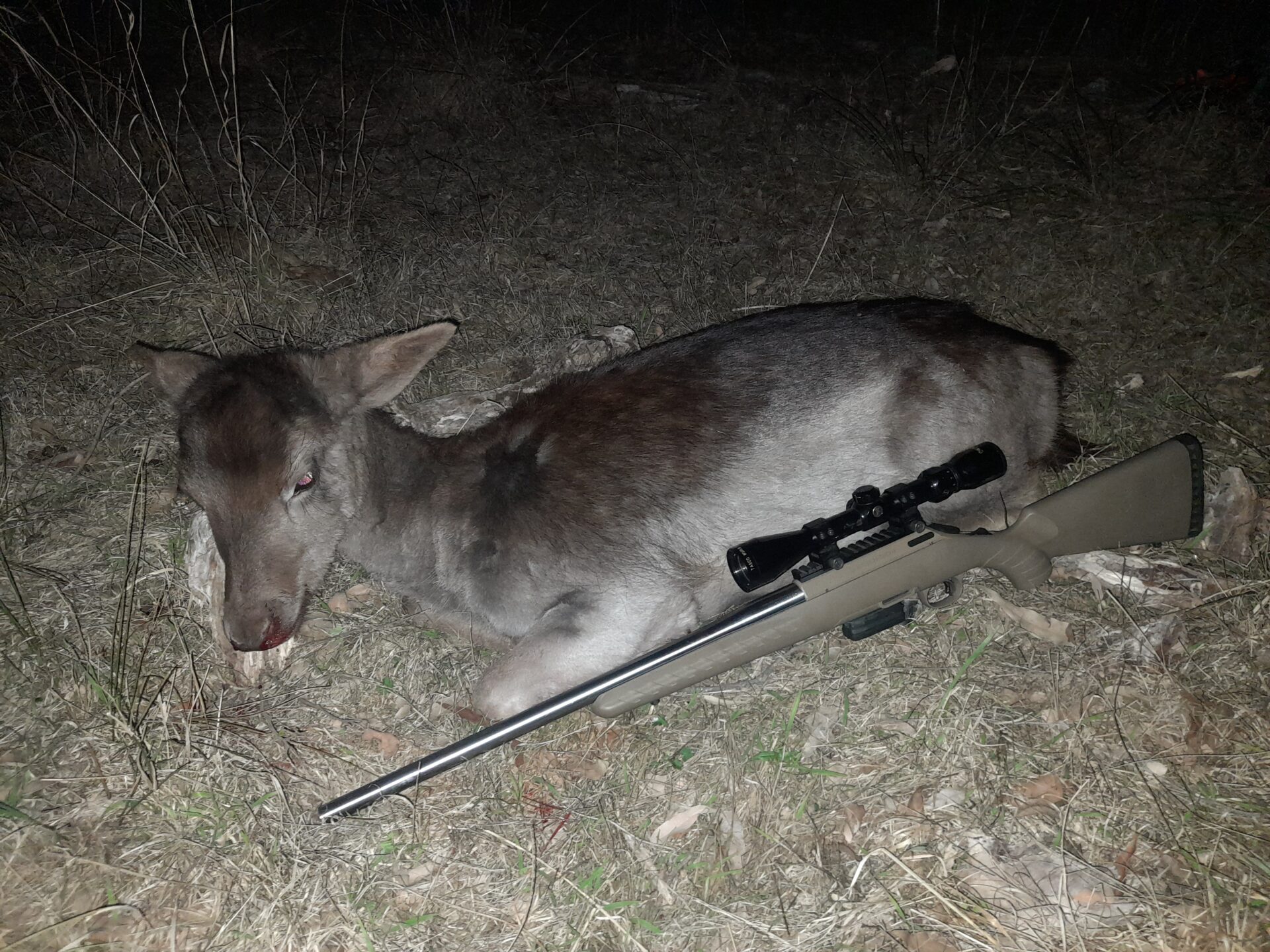
I watched those two animals until they crested a ridge with no sign of injury. Neither of them had been hit. I descended the very steep gradient to the valley floor and looked around, hoping so to see my deer lying on the green grass where she’d been grazing. Nothing! “How did I miss that shot?”, I asked myself out loud. I walked out of the timber to the middle of the gully and scanned around to see if there were any other deer further along. I spied two hooves poking up from a washout behind a large tree stump. There was my doe. She’d been feeding right on the edge of a vertical sided hole and dropped into it when I fired, dead in her tracks.
Now in almost total darkness, I snapped a few photos before breaking down the deer and bagging all the meat for the hike out. The trip out was by torchlight and picking my way around and over rocks on the steep climbs certainly got the quads burning. Two kilometres later, the weight of that pack full of venison was taking its toll on my shoulders but it was a very happy hunter who arrived back at the ute, still smiling with the result.
I was so happy with the .277 Lincoln that, within weeks, I had another rifle at Buffalo Gunsmithing being chambered. This one, on a Lithgow LA102 action, was fitted with a longer, varmint profile barrel for my personal use after the lightweight first edition was handed on to Lincoln’s father. This rifle required a little more lathe work, as the .223 bolt face need to be opened up to fit the larger diameter .277 Lincoln cartridge head. Fortunately, there is plenty of metal around the stout Lithgow bolts to allow this modification without compromising its strength. I’m yet to take the newer, varmint-barrelled Lincoln on a hunting outing but have been quite pleased with its performance during load development at the range. Groups measuring 0.4” with 130gr projectiles are achievable from the bench. ‘Watch this space’, as they say.