

Redding Big Boss II
Take control of your reloading needs
Review by Nick Rositano
Redding reloading equipment first started back in 1946 and was founded by Burr Bement. The company’s first product to ever hit the market was a beam style powder scale and since then Redding has grown to be one of the most reputable and reliable reloading equipment companies on the market today.
From the 1960s, Redding began to evolve and focus primarily on manufacturing reloading tools and equipment. Redding offers different levels of reloading dies from your entry-level full-length die sets all the way through to its flagship match-grade die sets, which feature a micrometeor for fine tuning of bullet seating purposes. With a lot of different reloading presses on the market today, and with a bit of research, I was eager to have a play around with the Redding Big Boss II, especially with its well-priced kit which retails for around the $850 a mark.
Reloading, in my opinion, is the most cost-effective way to be able to customise and develop loads that will produce the best out of your rifle in terms of accuracy and consistency where a lot of mass-produced ammo fail to do so. For those individuals who can put aside time and truly want the best out of their rifles, I urge you to go down the path of reloading.
Having been introduced into reloading by my late father as a young lad, I was able to gain an insight into the process of reloading and the basic steps. Safety is paramount and without a doubt the most important thing when it comes to reloading, as an overload can cause serious and fatal consequences.
During the past few years, I have found myself only using ADI powders, so I have opted to view all the loading data on their website, which is accessible to anybody at no cost. Be sure to follow load data in a reloading manual for the powder you are using at all costs and never start off with the maximum; gradually work your way up looking for any pressure signs in spelt cases.
The Redding Boss Pro-Pack comes standard with Redding’s flagship model and the highly respected Big Boss II press. This press is 100 per cent American made and features a high-density structure cast iron frame, making the press very rigid in reloading small calibres all the way through to the big Magnum cartridges on the market today.
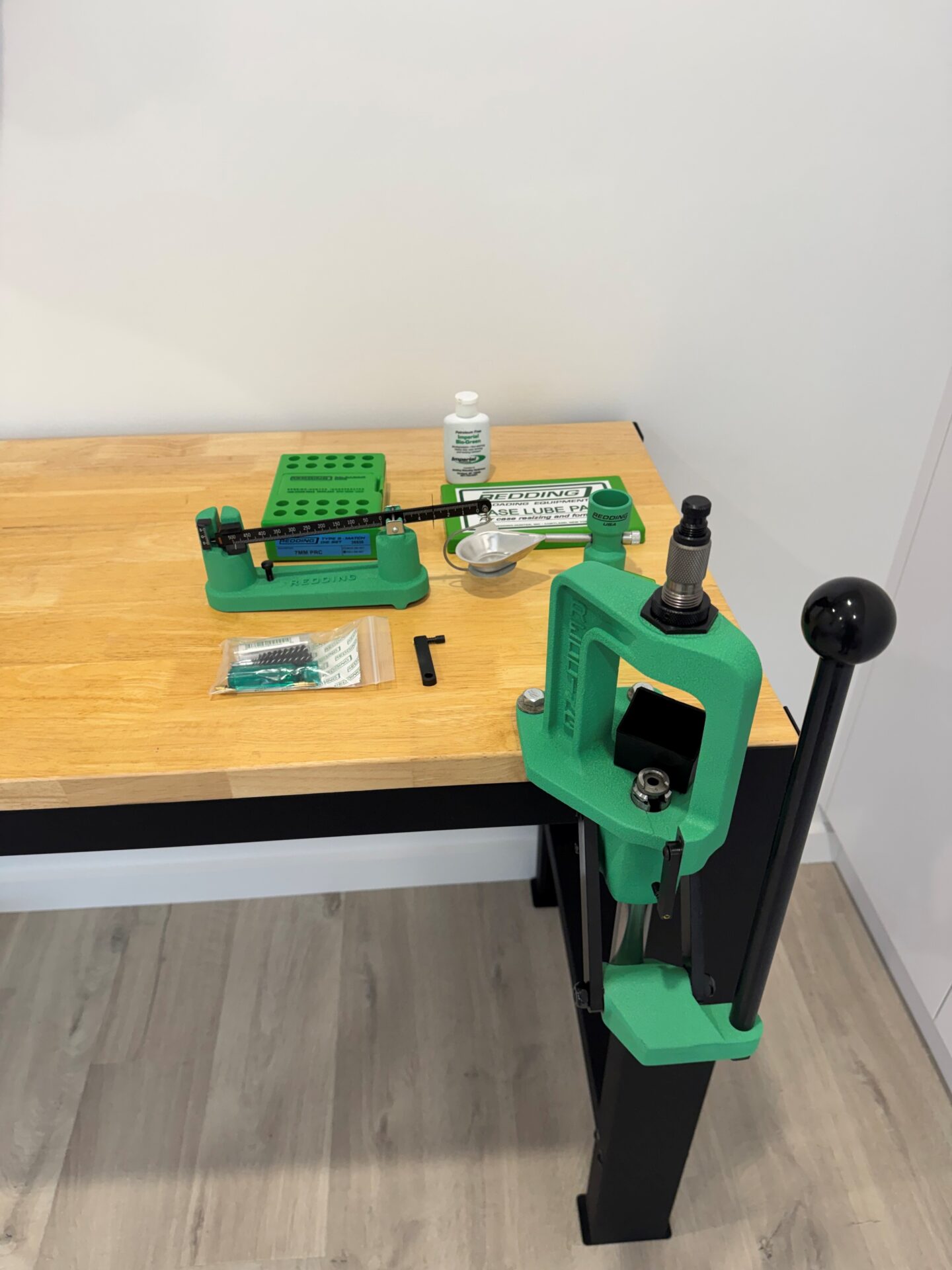
The Redding Big Boss II press features a larger ram and more useable ram, making those larger magnum calibres easier to reload compared to the original Boss press. The Big Boss II press features a smart primer arm, which automatically swings into position during the ram stroke and flicks out of the way when not in use. Some of the features and components that come standard with the Redding Big Boss Pro Pack include an offset handle, which gives the operator the most comfortable operating position while having the best visibility. A primer catcher comes standard in the kit too, while two primer arm assemblies – one for both small and large primers – are included. A Redding Model 2 powder and bullet scale are also included. A Redding powder trickler, pad style case lube kit, Redding’s case lube, deburring tool and Redding’s model 18 case preparation kit all form part of the Big Boss Pro-Pack, along with a powder funnel made from tough Lexan. All of Redding’s reloading equipment has been thoroughly and carefully inspected and is fully warranted to be free from defects in materials and workmanship for life.
After securing the Redding press to my reloading bench using two 10mm bolts around 75mm long with washers either side, I was keen to put the Redding Big Boss II through its paces and decided to start the process of full length resizing around 50 7mm PRC brass using Redding’s full length match-grade resizing die. I was impressed with the ram stroke and how efficient and smooth it is when full length resizing with no struggles at all.
At first glance, the press is built to be tough and Redding’s flagship colour green gives all Redding products a nice appearance.
The next step after full length resizing was the priming process; I have a handheld primer tool but opted to use the Redding Big Boss II for the process. For the primers, I was using Federal 215 magnum primers. The priming process was a breeze and unlike an old press, I have all the primers fed in with ease into the primer pocket. The Redding Powder Trickler, along with the Redding No. 2 Powder and Bullet Scale are a good bit of reliable and accurate equipment and will get the job done; however, if you plan on reloading in larger quantities or for multiple calibres, an electronic powder dispenser will definitely speed the process up, although the higher end of these units aren’t cheap.
The next and final step of the reloading process was to seat the projectiles. For this, I decided to do a bit of field-testing using Berger 195 elite hunters for the 7mm PRC after finding the Lands in the barrel. I decided to seat the bullets 0.020” jump of the lands. Using the Redding match-grade seating die, I knew that finding the seating depth would be a fair bit easier than in the past using standard reloading dies, which don’t have the micrometer feature and allows for a lot finer tuning in my opinion. I recommend anyone who is interested into getting into the reloading scene to look no further than Redding’s Big Boss Pro Pack, which features everything you need in order to get you into the reloading scene or for seasoned reloaders who are chasing a rigid and solid press to pass down to the future generations. The Big Boss Pro Pack retails for around the $900 mark, making it affordable while giving you the backing by Redding’s legendary products.
