

Lyman Electronic Digital Trigger Pull Gauge
The world’s most accurate trigger gauge
By Steve Marchant
Why do I need a trigger pull gauge?
No matter what your level of shooting expertise, if your firearm’s trigger pull weight is excessive or inconsistent, regularly placing accurate shots on target will be a challenge. Then again, if you shoot in a competition with a minimum trigger pull requirement, insufficient trigger pull weight may see you disqualified from your event.
For occasional shooters, shooters on a tight budget, or those who own just one or two guns, the best option is to have your firearm’s trigger pull weight checked by a gunsmith, who will also be able to adjust or replace it for you if required. But for shooters with several firearms, or those who shoot often, a trigger pull gauge is a very useful tool.
Mechanical or electronic (digital) trigger pull gauge?
Mechanical trigger pull gauges use a loaded-spring mechanism that incorporates a calibrated scale to display trigger weight pressure. Mechanical gauges are generally cheaper than digital gauge models, but they tend to be more difficult to operate than digital gauges and are not as accurate.
While more expensive than mechanical gauges, the best digital trigger pull gauges are very easy to use and give more accurate readings. One of the best digital trigger pull gauges available today is produced by Lyman Products.
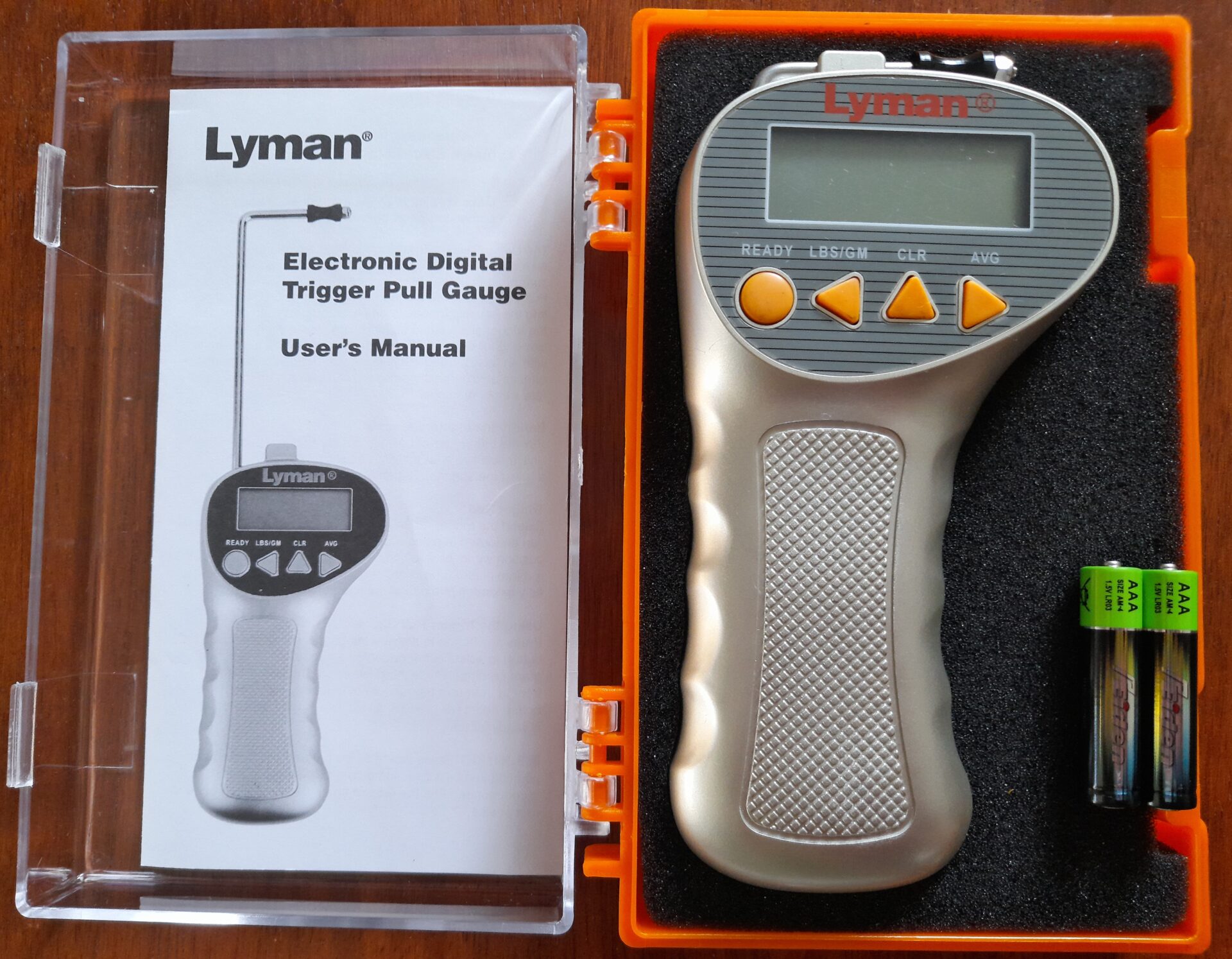
Mechanical trigger pull gauges are cheaper than digital gauge models, but they are generally more difficult to operate and not as accurate.
Lyman Products – a brief history
William Lyman’s patented No. 1 Tang Sight launched the Lyman Gun Sight Company in the late 1800s, and in 1925 the Lyman family purchased Ideal reloading products. Since then, Lyman has provided generations of reloaders with high quality reloading presses, dies, casting furnaces and bullet moulds.
Today, Lyman manufactures and distributes quality products within the shooting sports industry, with the development of many of these commodities directly linked to feedback from customers who purchase them. One such product is Lyman’s patented Digital Trigger Pull Gauge.
Lyman Electronic Digital Trigger Pull Gauge – basic operation and specs
The Lyman Digital Trigger Pull Gauge comes packed in a sturdy storage case within a foam cutout. When not in use, the roller hook is housed inside the gauge and clipped to the top of the unit for extra security during transport. The whole package is compact and lightweight, and thus readily and safely stowed in a range bag with other tools and equipment.
The gauge is powered by two AAA batteries and is very easy to use. First, withdraw the roller hook and click it into position. The roller hook can be rotated and locked into four different positions at 90° intervals, enabling the gauge to be used on almost any rifle, shotgun or pistol.
Below the easy-to-read LCD display screen, four orange buttons activate all available functions. Operation is fast. After making sure your firearm is empty and unloaded, press the ‘LBS/GM’ button to select pounds/ounces or kilogram/gram readings. Then press the ‘Ready’ button, and an audible ‘beep’ indicates the gauge is ready for use. Next, locate the roller on the trigger and draw back on the unit gently and steadily until the trigger breaks, and the pull weight is displayed on the screen.
Lyman’s digital trigger gauge has a measuring range from 1oz (2.8g) to 12lbs (5.4kg), and the state-of-the-art strain gauge technology produces accuracy of +/- 0.1oz (2g).
| Lyman Digital Trigger Pull Gauge – Specifications | ||
| Measuring Range | 1oz – 12lbs / 2.8g – 5.4kg | |
| Resolution lbs/oz | 0 – 5lbs: ± 0.1oz | 5 – 12lbs: ± 0.5oz |
| Resolution kg/g | 0 – 2.2kg: ± 2g | 2.2 – 5.4kg: ± 10g |
The gauge will display and hold the exact trigger pull weight until the ‘ready’ button is pressed, or it will shut down after a few minutes to save the battery. It also automatically calculates the average pull weight of up to 10 individual readings. To display the average, press the ‘AVG’ button. Before starting a new string of readings, the ‘CLR’ button is pressed to erase the memory.
‘Road testing’ the Lyman Electronic Digital Trigger Pull Gauge
For The Report, I tested the Lyman digital trigger gauge with a S&W target revolver, a stock semi-auto Glock pistol, and a Lithgow LA102 .243 rifle. The revolver was cocked and dry-fired single action, as it has a hammer mounted firing pin, and dummy rounds were used in the Glock and the Lithgow to protect their firing mechanisms. Ten consecutive trigger pull readings were taken on each of the firearms. To minimise personal bias, I got my wife and a shooting mate to take a few readings for me, and their results were within the same range of variability as mine. The test data is provided in the accompanying table.
| Lyman Digital Trigger Pull Gauge Test – Data | ||||
| Test Firearm | S&W Revolver | Glock SA Pistol | Lithgow Arms Rifle | |
| Trigger Pull Weight Readings | Test #1 | 1lb 13.3oz | 5lb 8.6oz | 3lb 2.1oz |
| Test #2 | 1lb 13.1oz | 5lb 11.3oz | 3lb 5.0oz | |
| Test #3 | 1lb 13.0oz | 5lb 10.2oz | 3lb 4.8oz | |
| Test #4 | 1lb 13.6oz | 5lb 6.4oz | 3lb 3.3oz | |
| Test #5 | 1lb 13.5oz | 5lb 9.0oz | 3lb 4.6oz | |
| Test #6 | 1lb 13.6oz | 5lb 6.4oz | 3lb 3.8oz | |
| Test #7 | 1lb 13.5oz | 5lb 8.9oz | 3lb 2.1oz | |
| Test #8 | 1lb 13.8oz | 5lb 7.0oz | 3lb 4.9oz | |
| Test #9 | 1lb 13.0oz | 5lb 9.1oz | 3lb 4.9oz | |
| Test #10 | 1lb 13.8oz | 5lb 9.8oz | 3lb 2.6oz | |
| Mean Pull Weight | 1lb 13.42oz | 5lb 8.67oz | 3lb 3.81oz | |
| Pull Weight Range (Highest – Lowest)) | 0.8oz | 4.9oz | 2.9oz | |
Three words are sufficient to describe the results of my tests: fast, easy and precise. In terms of speed, it only takes a couple of minutes to learn how to operate the gauge. After that you’ll spend more time getting the gun out of your safe than you will running some trigger tests on it. The ergonomics of the unit and the ability to lock the roller hook into four different positions contribute to a smooth, consistent draw-back of the gauge, which in turn produces tremendous consistency in the readings.
Not surprisingly, with its ‘worked’ trigger and well over 10,000 rounds fired, my target revolver had the lightest and most consistent trigger pull readings, averaging 1lb 3.4oz trigger pull weight and a range of only 0.8oz between the lightest and heaviest readings. The Glock trigger pull results were also largely as expected, with an average pull weight of 5lb 8.7oz and a range of 4.9oz. I was, however, quite surprised by the trigger pull readings on my Lithgow .243. Its trigger pull weight was checked when the rifle was new and measured around 3lb 12oz. Since then, 200-plus rounds have been put through it and now the pull weight averages 3lb 3.9oz at a range of 2.9oz. A firearm’s trigger pull will often ‘smooth up’ after several hundred firings, but I didn’t expect the pull weight to reduce by so much, so quickly. I’m very happy with the trigger on my LA102, and this test demonstrates why shooters competing in matches with minimum trigger pull requirements pay regular attention to their firearm’s trigger pull weight.
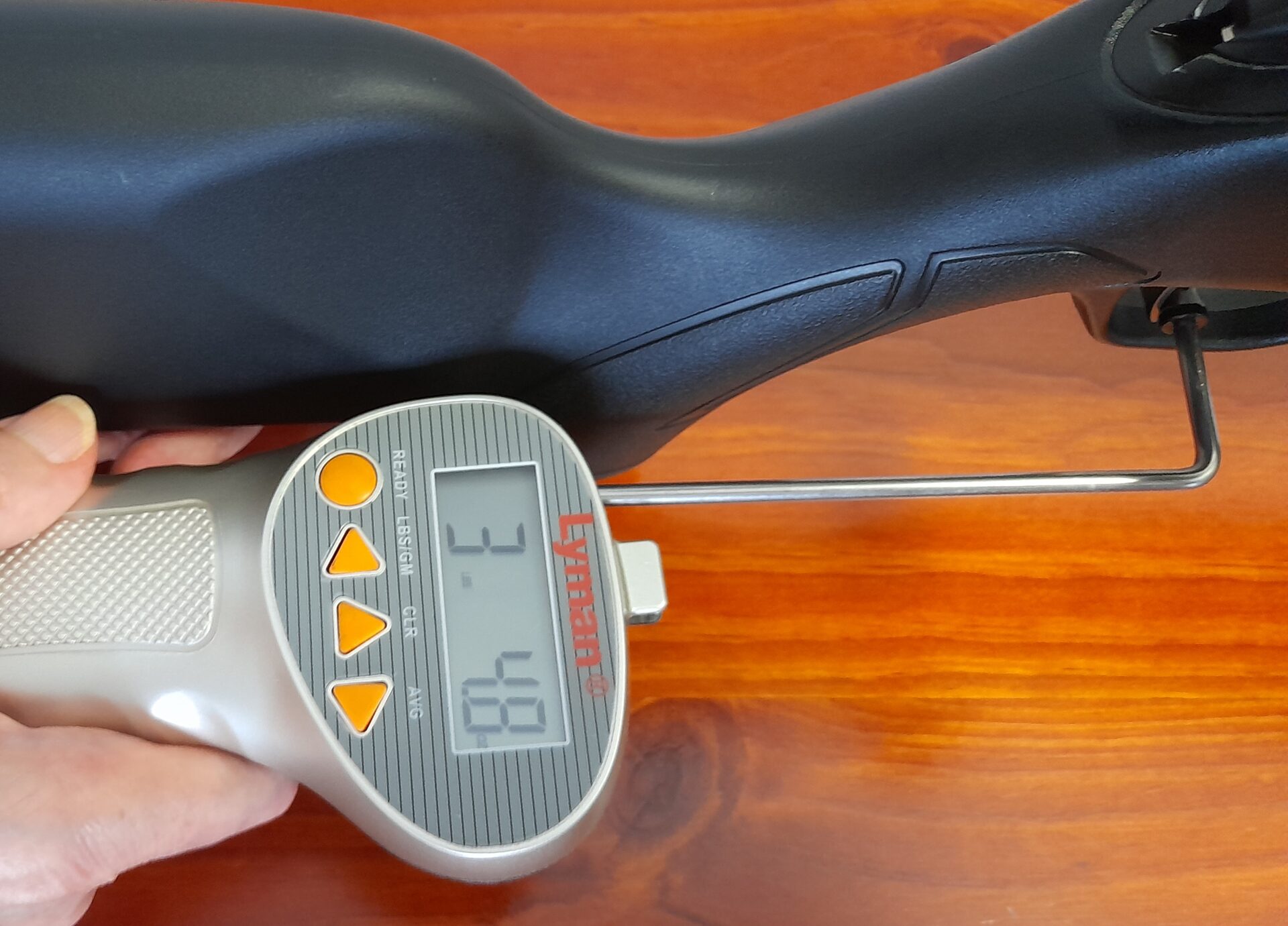
The author is very happy with the trigger pull weight on his Lithgow LA102.243, which ranges from 3lb 2.1oz to 3lb 4.9oz.
Summary/conclusion
Lyman’s revolutionary Digital Trigger Pull Gauge is designed to be the fastest and most accurate trigger pull gauge available. Its position-adjustable roller hook enables quick and precise measurement of trigger pull weights on pistols, rifles and shotguns. State-of-the-art strain gauge technology produces accurate measurements from 1oz to 12lb (2.8g – 5.4kg) pull weight. The Lyman Digital Trigger Pull Gauge retails for around $170 to $190 and comes with a 12-month warranty. It is the perfect tool for measuring a firearm’s trigger pull weight accurately and easily.
