

Evolve with an SCSA Taipan Evo
By Neil Schultz
For my birthday in 2024, I shouted myself one of the original Taipan Light models in .223, just to add another Australian-made firearm to the suite of tools I use for pest animal management. During the following year, scores of feral cats, foxes, and pigs fell to the little carbine. After more than 1,100 rounds through the barrel without a hiccup, I opted to trade up to a larger calibre, the .300AAC (aka .300 Blackout). I purchased the updated model, the Taipan X, which I’ve since put to use in the field tipping over pigs and deer just as enjoyably as my earlier Taipan.
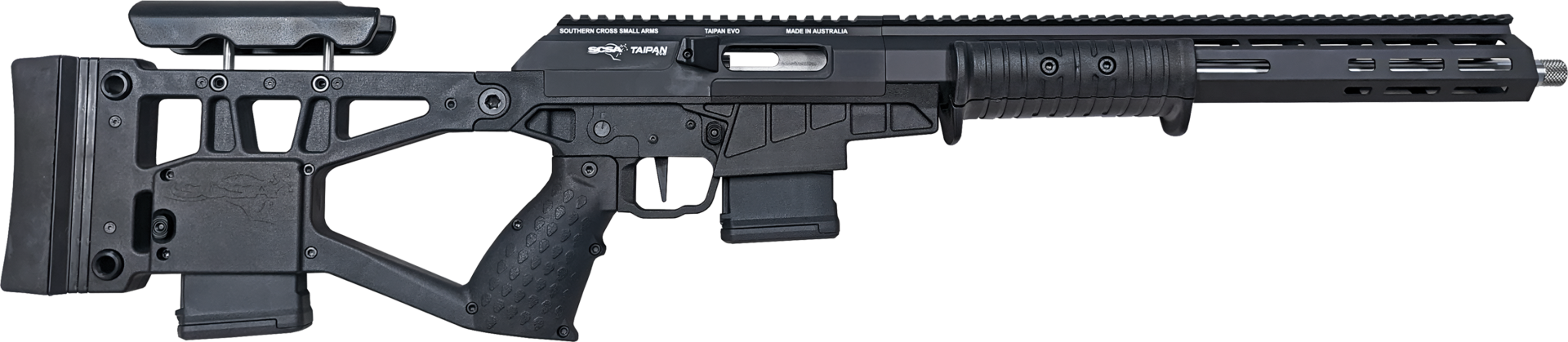
Following its path of continuous improvement and attention to consumer feedback, Southern Cross Small Arms (SCSA) recently released the third of its Taipan models, dubbed the Evo. Significantly differing visually from the previous Taipans, the Evo has been humorously described as having a ‘Starship Trooper’ appearance. After seeing the Evo, I immediately regretted not waiting for them to be available in .300AAC before buying my X. The Evo looks cool!
Changes to the Evo are not purely cosmetic. In a departure from the all-alloy buttstock of previous models, the Evo is constructed from a carbon-fibre reinforced polymer. This reduces the overall weight but, more beneficially, allows greater flexibility in the design. Curves and texturing are moulded into the polymer, giving a practical and aesthetically pleasing result. The ergonomics of the Evo’s stock are spot-on with the new grip filling the hand perfectly while allowing the wrist to be in a neutral position while firing. Previous features, like the adjustable cheek riser and length of pull, are still included. Two QD sling sockets are situated on each side of the butt; however, to mount a sling you’ll need to add an M-Lok stud to the alloy fore-end. Underneath the rear of the butt is a housing that carries a spare magazine. That is a feature unique to the Taipan Evo.
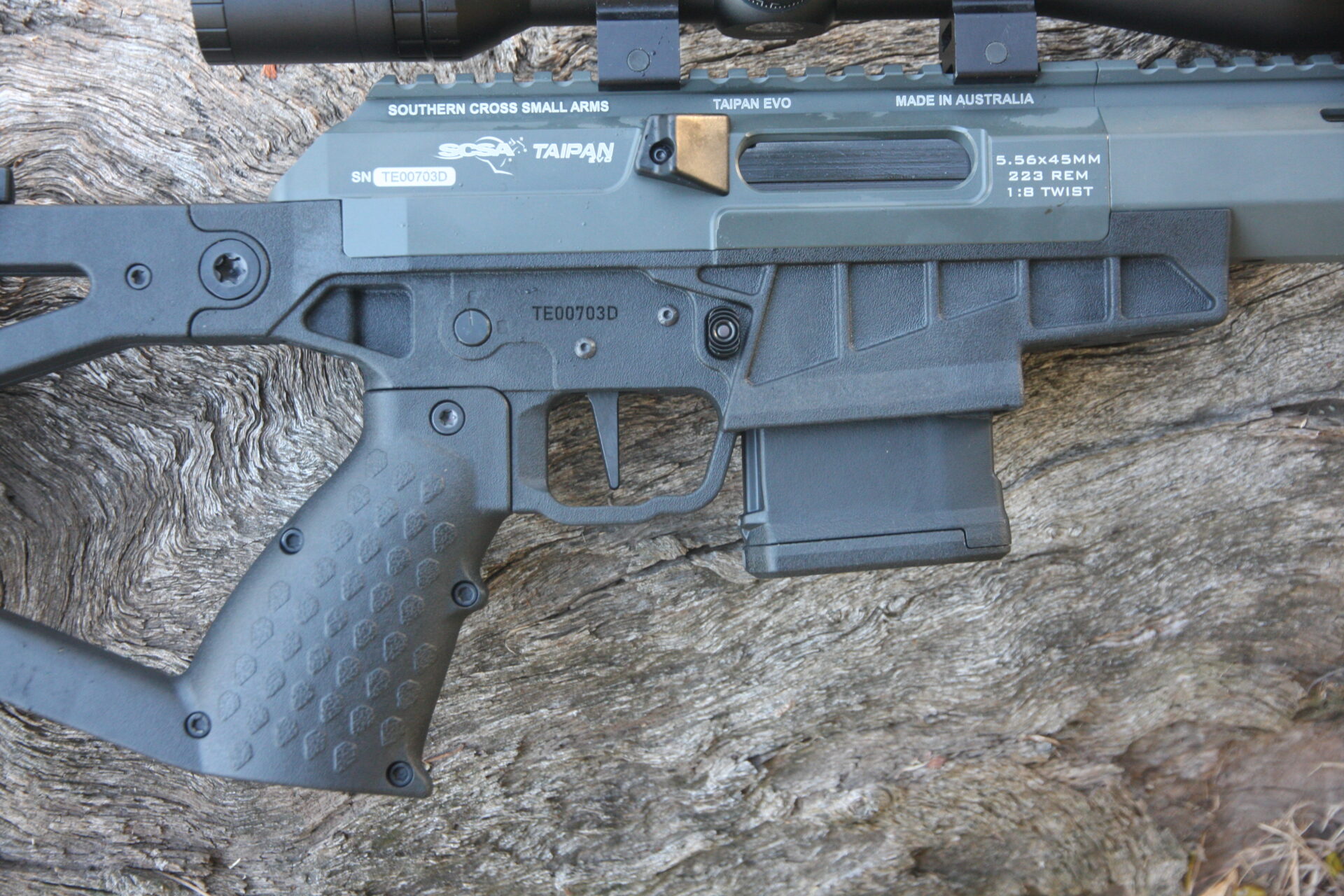
Another improvement in this rifle is a flared magazine well, aiding in speedy ‘mag’ changes when it matters. Previous Taipans relied on the follower in the P-mags to prevent the action closing on an empty magazine. The Evo has been fitted with a mechanical bolt lock that holds the action open when the magazine is empty. This allows the magazine to be dropped and a full ‘mag’ inserted. Then just a slap on the bolt catch releases the bolt to chamber another round; very efficient.
On top of the Evo is the familiar full-length Picatinny rail common to all Taipan models. This allows a host of mounting options for optics. I fitted a standard 3-9 variable Nikko scope to allow a wide field of view for close-quarter hunting in thick bush and more precise targeting on smaller ferals at greater distance as opportunities arose. If close range targets are your usual scenario, consider a red dot or a Low Powered Variable Optic (LPVO). Red dots give the advantage of being able to shoot with both eyes open, allowing greater situation awareness – an ideal option for jumping pigs from cover. Fitting an LPVO with a magnification range from 1x also provides that very wide field of view with the option to zoom in as required. Today, there are LPVO scopes ranging from 1-4 power right up to 1-10, which allows great leeway for ranges from point blank to as far as one would be likely to be using a .223 carbine.
In the field
As mentioned, the polymer buttstock and lower receiver have reduced the overall weight of this rifle a little (300g) when compared to the previous models. That said, I liked the balance of the Evo. It still swings and points quickly and intuitively and doesn’t feel front end heavy at all. After sighting in the rifle at 100m, I shot a few groups, resting on the tray of the ute. Accuracy with factory ammunition running 55gr soft point projectiles yielded consistent 1.1 MOA five-shot groups. I also fired test groups with Hornady factory loads tipped with 35gr NTX bullets, with results ranging from 1 to 1.3 MOA. At the other end of the scale, I shot heavier offerings with 69 and 75gr projectiles for averages of 1.6 MOA at 100m. Conveniently, for those who buy factory ammo, on the day, the Evo produced the best groups with the most commonly available 55gr loads.

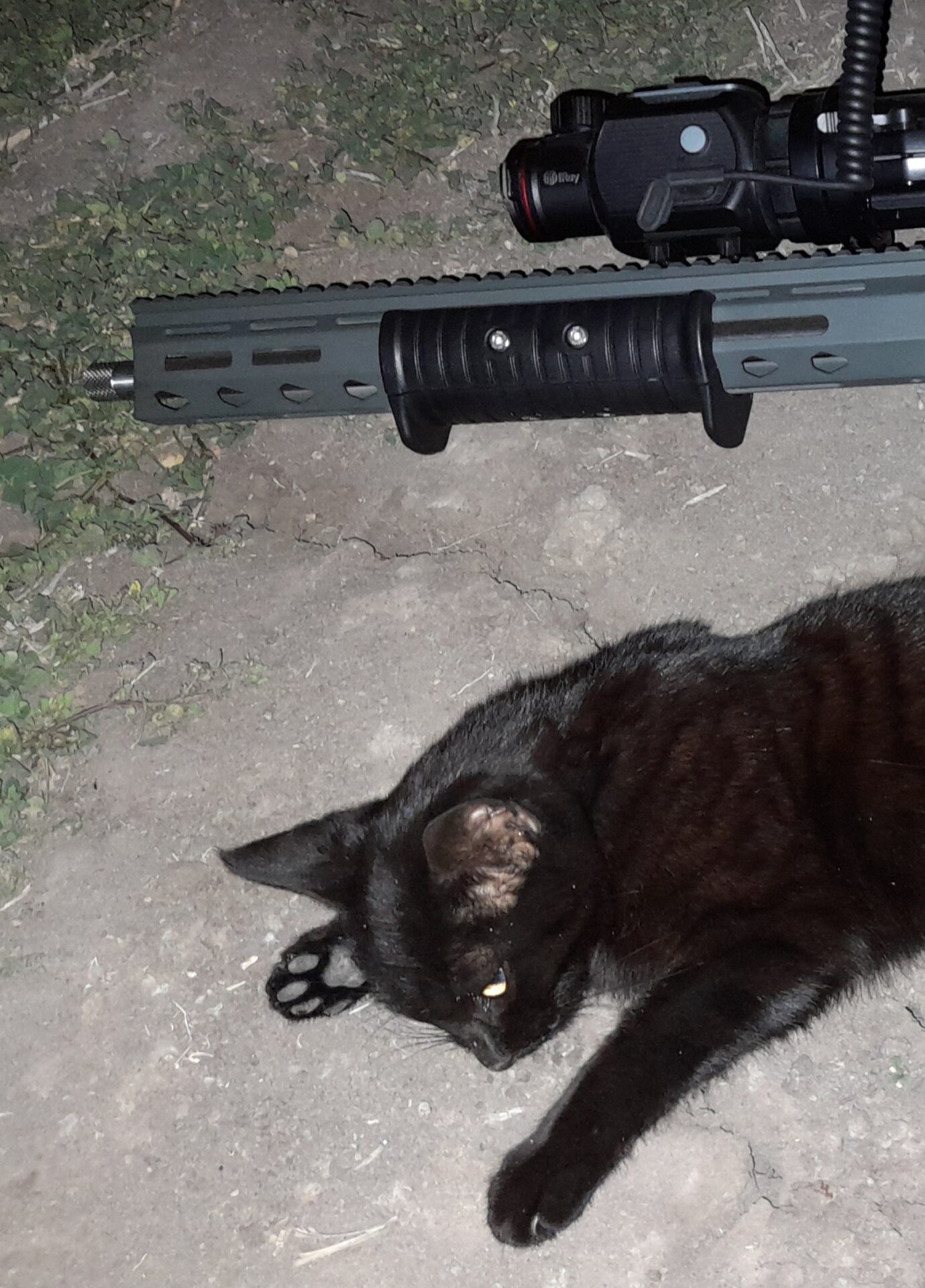
After messing around shooting paper for the afternoon, I added a clip-on thermal to the Evo for some nocturnal hunting. Whether targeting deer or pigs, I always take out any feral cats that are seen. Those feline killing machines wreak havoc on our native wildlife. Foxes are also targets of opportunity, especially when hunting on properties running sheep. I am often asked to knock fox numbers down during the lead up to lambing season, for obvious reasons. I carried the Evo around the hills in the dark, enjoying a moonlit night. The short overall length of the rifle made it easy to carry. Just swinging by my side while carried by the pistol grip, the muzzle cleared the ground comfortably. Pigs were not encountered, probably due to the drought conditions of the New England region during my hunt. I did, however, manage to find a feral cat sneaking around one of the dams. The Evo proved accurate enough to end ‘Felix’s’ destructive days.
My first Taipan, the Light model, was not equipped with the spring-assisted pump action mechanism and after using the later models one can appreciate the noticeable benefits of this addition to the Taipan lineup. I don’t run the optional bolt handle that comes with the Evo and X models, as I always use the rifle offhand or from sticks. The agility of the pump action is a draw card for most Taipan buyers, me included. As with the X model, the Evo’s upper receiver is machined from 6061T6 alloy for durability. The steel bolt carrier houses the bolt assembly with its seven lug, rotating bolt head. A chunky fore-end polymer grip allows the pump to be worked rapidly without the risk of slipping from one’s grasp. Five spacers for length of pull adjustment come with the Evo, but it fit my frame with the two installed from the factory. The single-stage trigger is fairly heavy, testing around 5½lbs but it breaks crisply with no discernible creep. If the Evo trigger wears in, as did my first Taipan, it will become a little lighter with use.
New to the Evo design is the ability to swap out the trigger to any AR compatible trigger. There are numerous variants available, but I’ve found one’s trigger finger soon adjusts to the Evo factory-installed trigger group.
I would expect most Taipan buyers are looking for a fast-handling, close-range pig managing tool and this neat carbine is in its element in that role. I had no trouble lobbing multiple rounds into ‘minute of pig’ groups offhand, rapid fire. When shooting from a rest, deliberate shots were accurate enough to nail small targets like foxes and feral cats without difficulty. All of the Taipans I’ve fired have been surprisingly accurate for a short-barrelled, pump-action carbine. This is no doubt a reflection of the quality of the stainless barrels sourced by Southern Cross Small Arms from Germany.
Overall, I found the Evo to be a practical firearm for Australian small-game hunting and pest animal management. The price point is very attractive, too, at about $1950. If you are a fan of Australian-made products, you should certainly consider adding a Taipan Evo to your gun safe.
