

Pity the public servants tasked with the impossible

While the taxpayer pays for the distraction
By David Henty
There is no denying the rebuild of Australia’s firearm registers is an epic task comparable to climbing Mount Everest for state and federal public servants. The four-year program to rebuild the eight firearm databases to allow them to be connected to a national registry was already incredibly difficult and has now been further complicated by the consequences of governments’ kneejerk reactions to the Bondi Jewish massacre last year. While there is little consistency in state responses to the federal government’s call for firearm buybacks and ownership caps, it is the responsibility of the public servants to attempt to make sense of poor government policy. They are tasked with interpreting policy, establishing a plan for implementation, then actioning with the many other stakeholders while working to a budget. Thankfully, firearm laws are under the control of the state government, and the Queensland Crisafulli Government has said no to the federal government’s calls to buy back legal firearms and limit the number of firearms licensed and fit and proper-approved citizens can own. Potentially, a few other states and territories may also follow Queensland’s lead and rebuff the calls to further hamper their legitimate firearms owning communities.
The difference between the calls to restrict firearm ownership after Port Arthur and Bondi are stark and even those without an interest in firearms, and some in the media, could smell a rat after Bondi. Prime Minister Albanese dismissed accusations his government ignored rising anti-Jewish behaviour in Australia, like the marches to celebrate the murders of 378 young Israelis at a music festival by Hamas barbarians. The NSW Premier Chris Minns jumped on the same deflection boat, eager to talk about firearms rather than the anti-Jewish hatred simmering in the Western electorates of Sydney and the soft responses by his fellow politicians.
The NSW Liberal Opposition were telling in their failure to call out the deceitfulness of supporting firearm restrictions instead of clamping down on racist poison spreading, opting for ‘me too’. These demands for further government interventions and firearm ownership restrictions on its citizens were a deeply cynical response and must be called out for the dishonest narratives that they are. Calls by terrorist supporters on the steps of the Sydney Opera House yelling, ‘From the river to the sea’ and calling for the destruction of Israel have nothing to do with firearm ownership and everything to do with antisemitism and hatred. The governments at both the federal and NSW level were trying to cover up their decisions to allow antisemitic and racist behaviour to fester rather than taking action to punish it and protect those targeted.
About $160 million has already been earmarked for the National Firearms Registry, which is meant to be finalised by 2028. And now the costs of post-Bondi potential firearm buybacks and increased bureaucracy in firearms licensing and registration need to be taken into account. How many millions of dollars of taxpayers’ money are being used to further political dishonesty and deflection? Both the Liberals and the Labor parties need to realise the electorate will not stand for being treated like mugs and this is reflected in the current public cynicism of the two-party system that is failing to produce tangible actions on everything from the state of our defence forces, energy stability, housing and public safety. Will we live long enough to see one of the new submarines or have reasonably priced power again? Will our children and grandchildren be able to afford their own homes and will the police and policies focus on the unlawful not the lawful public?
Be it as the electorate, legitimate firearm owners or taxpayers – we deserve better.
Carriage of the National Register
‘on track’ according to drivers
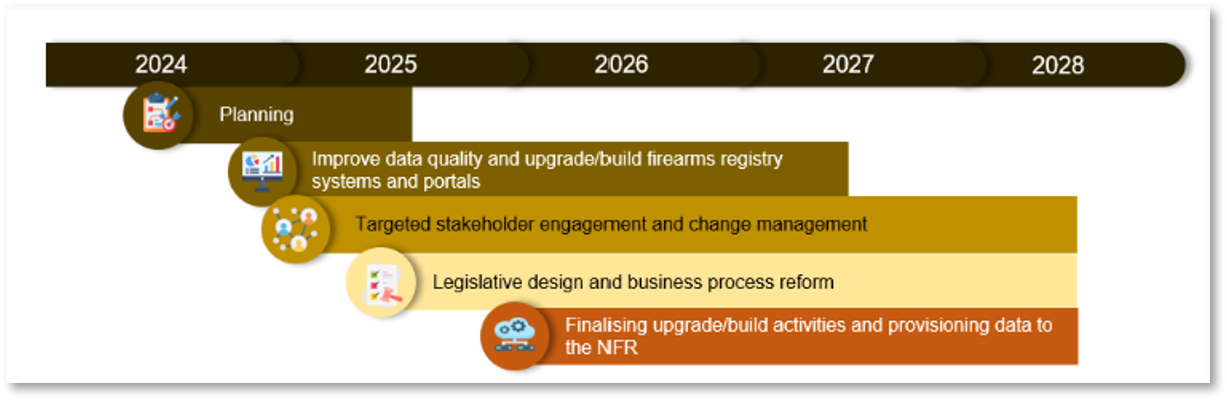
Firearms lobbyist and The Report Co-Managing Editor Tim Bannister met with senior staff from Home Affairs in Canberra to discuss the ongoing roll out of the National Firearms Register. According to internal key performance markers, the Register progression is on track. The roll out is reliant on the state and territory governments rebuilding or ‘cleansing’ their firearm databases so that they are accurate and can be connected to a future national register. Insiders from firearm registries have previously said that many of the databases are about one-third inaccurate.
Responsibility of firearms policy has recently shifted from the Attorney General’s office to Home Affairs under Minister Tony Burke. Most of the staff were simply transferred, while a lot of the management will now be handled by the massively funding-increased Australian Criminal Intelligence Commission (ACIC) who had this to say about the current state of play:
National Cabinet has set a target to complete the National Firearms Register (NFR) by 1 July 2028 to help improve community safety. In January 2026, Police Ministers and Attorneys-General agreed to accelerate the NFR. The Australian Criminal Intelligence Commission (ACIC) expects new capabilities will be ready for states and territories to adopt by the end of 2026.
Each state and territory will join at different times, depending on how ready their systems are. Some benefits are already being seen as systems are updated and data improves. The NFR will help law enforcement know where registered firearms are, who has them, and what risks to the community may exist.
Tim said he appreciated the time the staff made for him now and in the past representing the Australian Shooters Alliance (ASA) as a key stakeholder in the process. “If there is something beneficial to come out of the National Firearms Register, it will be in the state databases being a lot more accurate than they have been in the past. Errors in databases have often been blamed on firearm owners who are then punished through no fault of their own,” Tim said.
