
Give the bow a go
By Wayne Kampe
As a bow hunter with more than three decades’ experience, Wayne outlines the first steps into this exciting sport – from the bow shop to the target range.
So, what’s with this bow hunting business? It’s long been a part of modern hunting life – although never approaching the scale of rifle activity – yet to step into a retail archery outlet these days is to see folk behind the counter very busy indeed. Equipment’s well displayed with customers enquiring about various aspects of the sport, bows being assessed and perhaps tried. There’s a prevailing hum of things happening; bow shops are busy these days.
A resurgence then? And why not? Prolific YouTube bow hunts grip the imagination – perhaps making it look a bit too easy. And there are also definite advantages to bow hunting that make the concept very attractive these days: it’s silent and safe, so ideal for more confined hunting areas. And it’s farmer friendly.
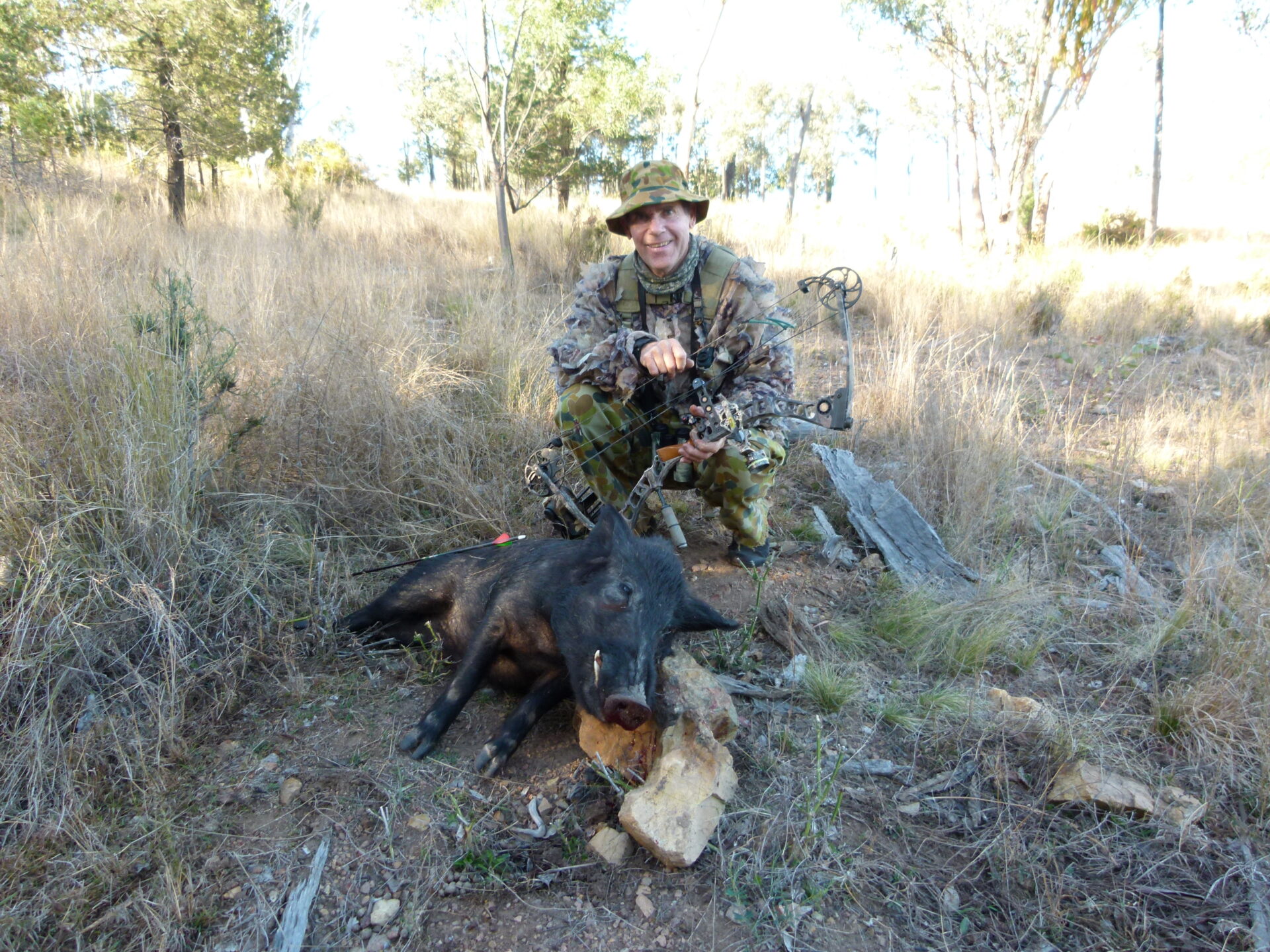
Hunters rejoice at a greatly upgraded hunting craft putting them within range of a highly regarded game animal. Drawing a bow on an unsuspecting deer at 30 metres is a primal experience, nothing less.
The compound bow
Let’s expand the picture and start at the beginning. Basically, there are two styles of bows mainly favoured today: compound and long (traditional style), with compound bows being more popular in the field over their long-bow cousins. The latter are lighter, but fine accuracy falls away because sighting systems are not fitted. It’s learned judgement (after mega practice) when a long bow is in the paddock; by contrast compound bows feature precise sighting systems, making them far more suitable for the humane despatch of game animals, a definite priority of ours, of course.
Why not consider crossbows as well? They are classified as M class – licensed weapons with restricted ownership.
Let’s talk about ‘let off’
A compound bow’s system of cables and cams reduce final draw weight (i.e., strength) by providing considerable mechanical leverage at full draw. This capability is referred to as ‘let off’ and can be as much as 75 or even 85 per cent of a compound bow’s nominated draw weight; thus, making it far easier to hold the sight onto a target. Yes, there will be strain, as any compound bow is drawn, but a bow that’s drawing 60 pounds (note: archery terms are old school) might be held drawn at 15 pounds or less.
A peep at the sight system
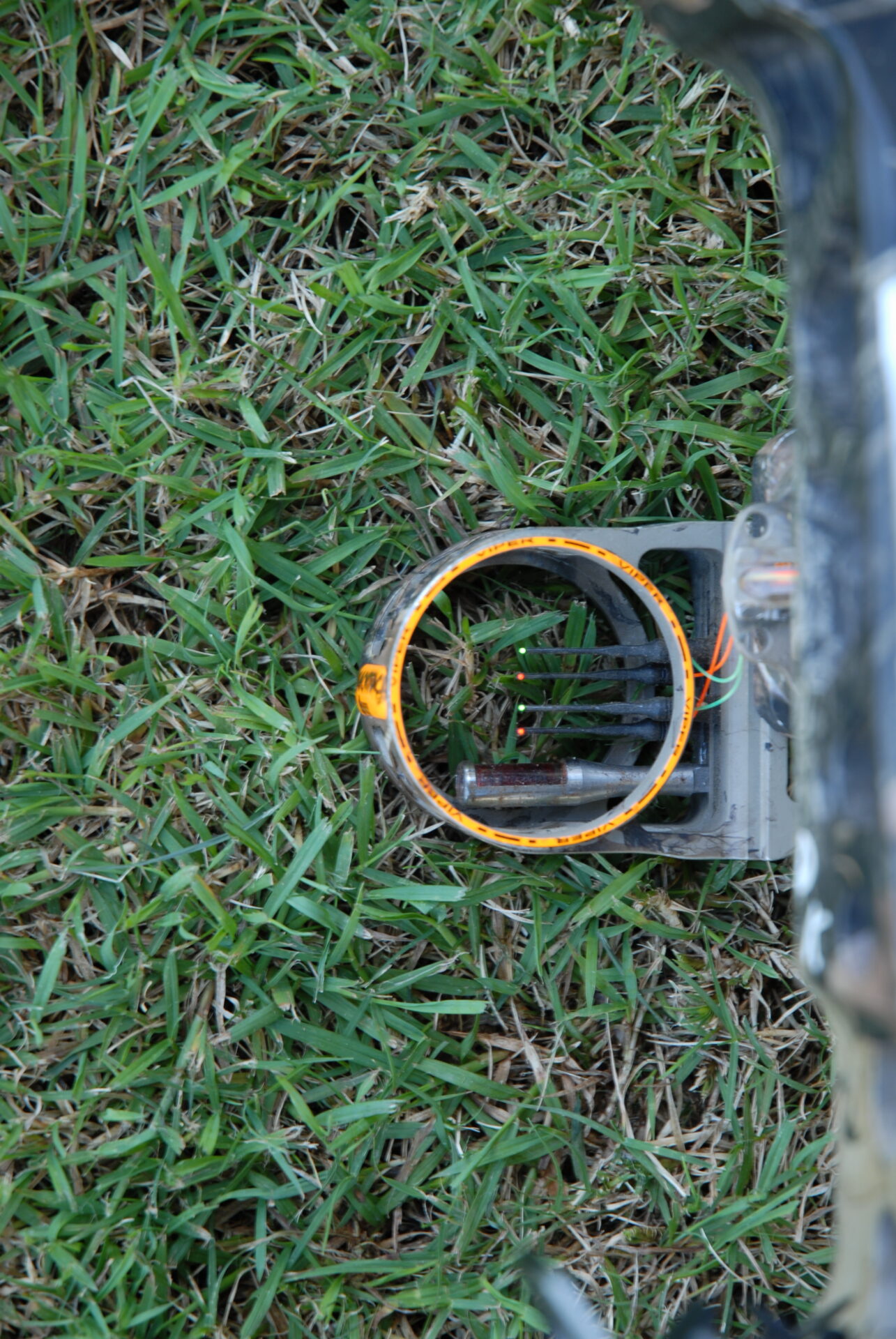
Aiming a compound bow is achieved via a peep sight within the string, which aligns with the dominant eye. The front sight consists of graduated pins at graduated intervals (usually 10 metres) within a housing on the bow’s riser or the central hand gip area to cater for differing ranges. Realistically, the furthest pin should be at one’s maximum confident range, whether that be 30 metres or 60 metres. Single pin front sights will see the pin moving up or down for a shot, according to distance.
To ensure accurate range estimation, a range finder is virtually standard equipment for bow hunters, as even arrows from powerful bows drop in trajectory rapidly after, say, 30 to 40 metres.
Bow selection
Here, professional assistance is vital. A hunting bow for a beginner will not be found on any ‘marketplace’ listing; moreover, you cannot just survey the racks of bows at an archery outlet and walk out with a one that looks like it means business – not without ample assistance from the staff, that is. You see, a bow’s draw length needs to match the length of a user’s arm, so the staff will usually measure draw length and then show the customer a bow of correct draw length and of a draw weight to suit that person. Note: draw weight can be flexible with many compound models.
And, one last consideration, that the new bow does not overstrain the hip pocket. Somewhat sadly, there is no 70 per cent let off in that area!
Ancillaries
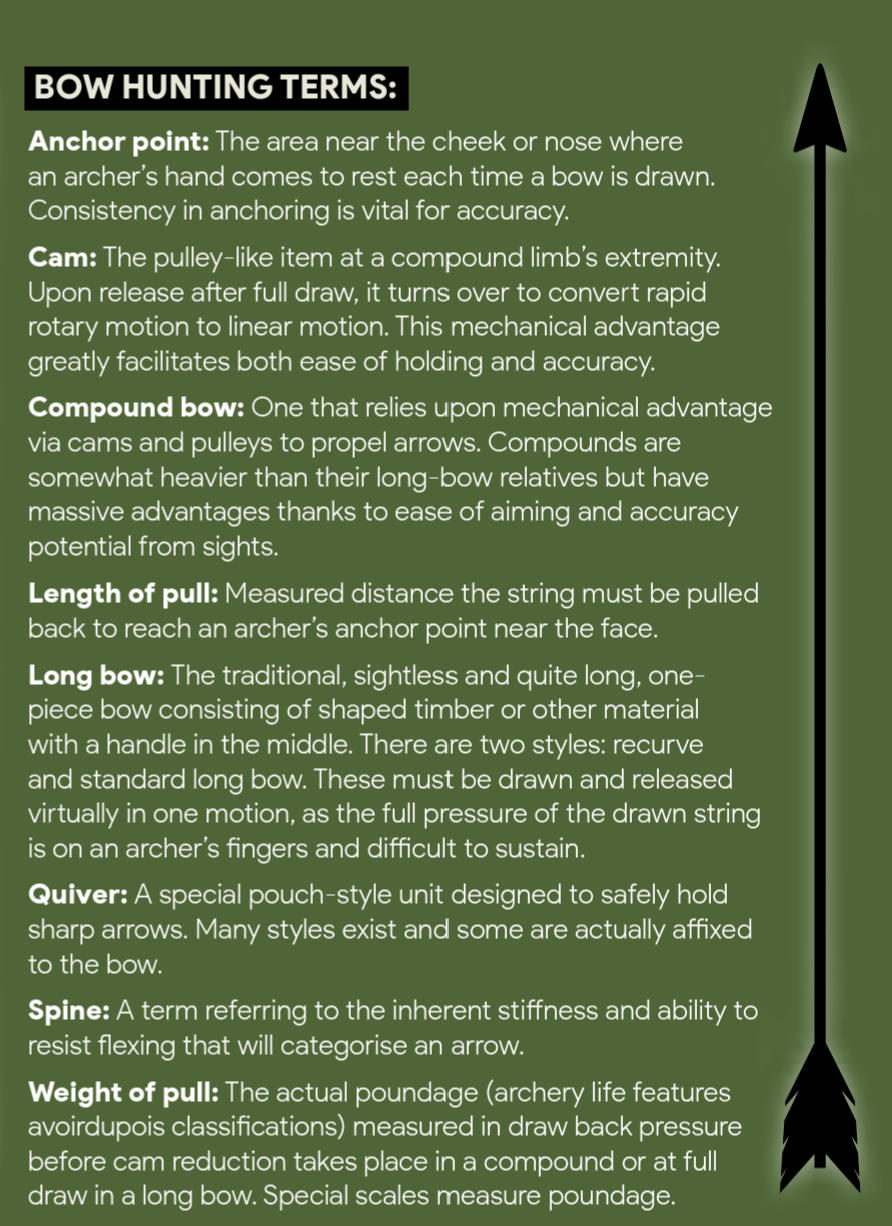
Arrows, made of carbon fibre, should match the bow regarding spine (or stiffness) to correctly suit a specific draw weight. Additionally, the bow should have sights and an arrow rest installed, with a quiver (case for carrying arrows) selected to safely accommodate razor-sharp broadheads in the field. And a release aid is vital, as it has a trigger that trips the string and is designed to facilitate smooth arrow release…because one cannot hold and release a drawn compound with just the fingers, there’s far too much string pressure. Ouch! Don’t forget an arm guard: a released string whacking the arm is another big ‘pain’!
Archery precedes hunting
So, you have that bow! It’s off hunting then? Well, no. Mastery of archery comes first and hunting later – likely a fair amount of practice hours later. It’s only when you are quite confident in your ability is it time to go for a hunt. Correct archery form is far from an innate sense, but getting professional guidance is easy, as most archery outlets have a range where initial shots can be taken under instruction. From then on, whether a long bow or a compound is your chosen hunting outfit, accuracy involves acquisition of consistency, both in aiming and let-off technique – one shot after the other with practice and more practice.
Shooting the bow
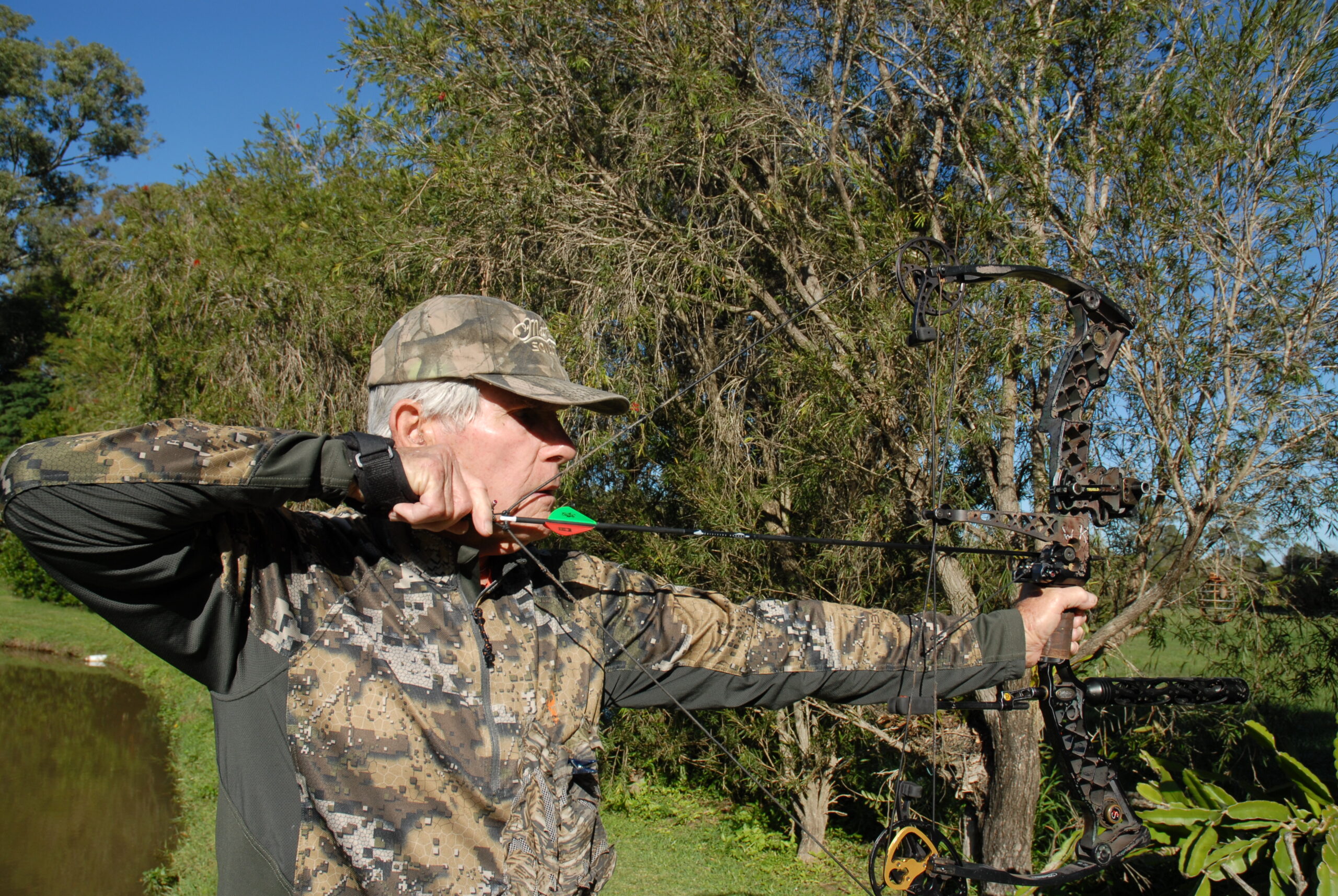
Basically, the technique (with range ascertained) is to draw the bow until the string is almost ‘kissing’ the cheek or tip of the nose. This is known as ‘holding the anchor point’, and it is maintaining the same anchor point every time that achieves consistency with aiming. The eye looks through the peep, then centres the appropriate front pin for distance onto the target.
Understand though, the bow must not be gripped tightly, or it will be torqued to one side or other with arrows following suit. Ideally, the drawn bow should rest back in the upright hand and, just after release the bow tilts forward, the hand closing to retain it. This is not an involved process and is easily mastered with practice.
With the bow at full draw and the sights lined up on the target, the trigger of the release aid is gently tripped to send the arrow on its way. Overall, it’s the continual pursuit for identical technique each time that will develop accuracy. Nothing else. Note that field archery clubs, some of them hosted on SSAA ranges, are invaluable for learning archery skills, as information and technique are backed up with animal-sized targets. Practice those heart/lung kill shots!
Get to the point
Arrows have varying points, threaded for interchangeability. Target work involves field points shaped similar to a sharpened pencil; hunting of larger game requires broadheads as sharp as possible. They should shave. Note that archery shop advice is required for both field point and broadhead selection relative to spine of arrow and draw weight of the bow, with ready reference tables reliable guides.
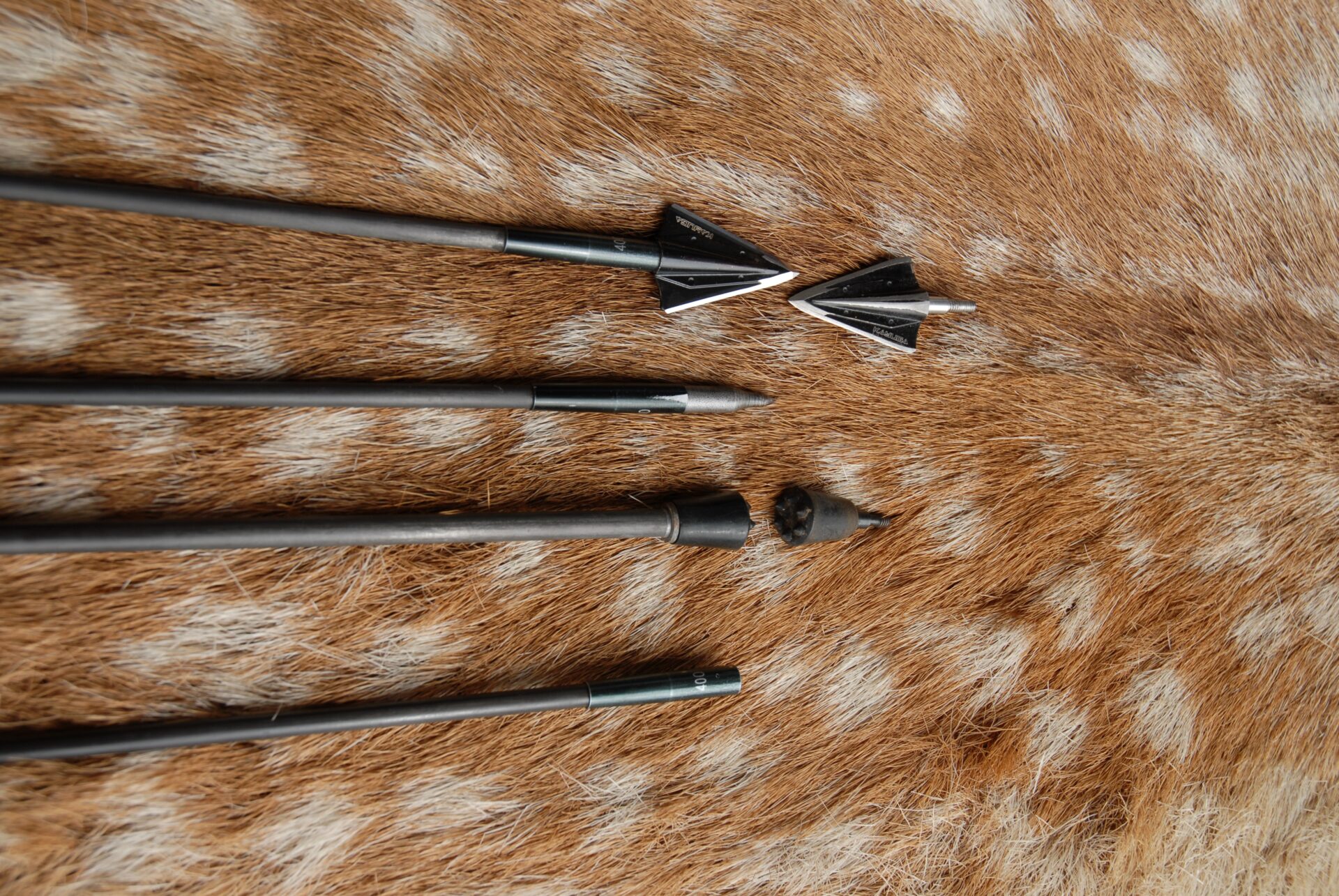
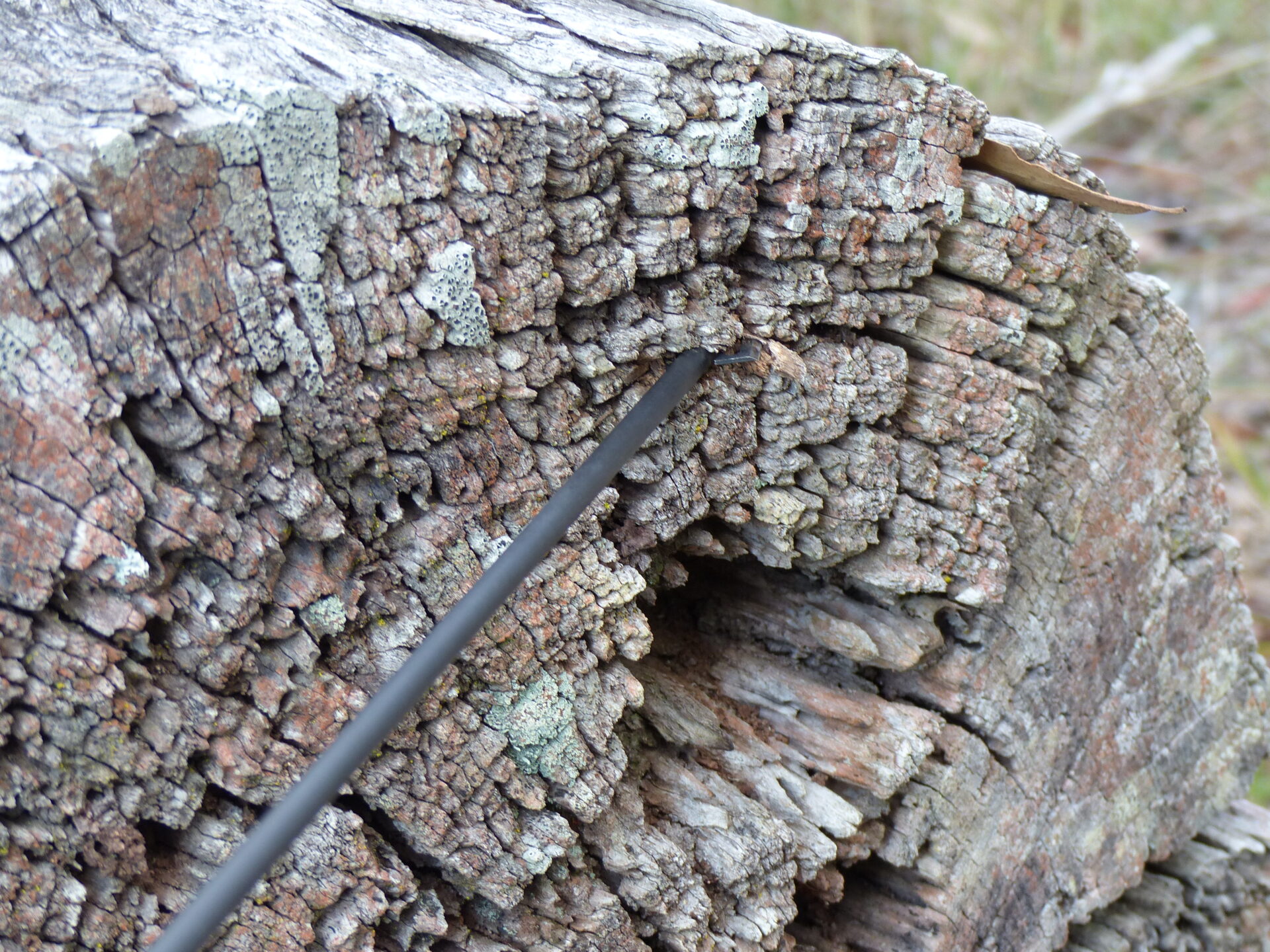
Rabbits require blunts – the best being somewhat broader items designed to smash said rabbit, which it certainly does. If a miss does occur, the blunt tips the arrow on ground contact and it can then usually be found. Not the case with broadheads and field points; they burrow. Gone – too bad! Blunts are great for shots at cow pats, grass clumps and the like for some paddock practice. It’s all fun.
Broadhead checking
With field point work going well at a target, it’s time to swap for a broadhead and check point of impact. Broadheads wreck things so a designated broadhead target is necessary. Again, back to the good old bow shop to buy a portable target for practice at the camp as well.
Interestingly, it’s not unusual to find that broadheads shoot to a different point of aim to a field point simply because of the difference in profiles. And while an expert might be able to ‘tune’ a bow to obviate this, Plan B is to simply alter the front sight, keeping in mind that an adjustment to move impact to the right requires the sight to move left and vice versa. Elevation requires moving the sight down. It’s called ‘chasing the error’; all archers are familiar with the term. Naturally, one makes a note of any sight pin changes.
Practise and legalities
A bonus of archery life can be the ease of practice. With suitable heavy-duty back stops, target practice at home is feasible provided your neighbours are not concerned about it and there is no possibility of an arrow exiting the property. That’s vital. Remember, bows are weapons and complaints to authorities will cause big problems, same as with any other weapon. Discretion with practice areas is everything.
Legally, bow hunting for ferals – and only ferals – is at a landowner’s discretion in the eastern states, with bow hunting bans in place in South Australia and Tasmania. Bow hunting in Western Australia and Victoria requires a permit.
Let’s go hunting
With confidence and ability up there, it’s time to put on the camo and take the bow and associated hunting kit into the paddock. Watch out for a future article, which will set out how to stalk close enough to use that bow to take your first hard-won trophy. Thrills and frustrations? You bet!