

Choosing a .22cal hot-rod

By Neil Schultz
Just a little while ago, 48 years to be exact, the very first centrefire rifle I purchased was a Parker Hale chambered in .22-250. Renowned as a real speedster, the .22-250 could launch a 40gr projectile at velocities exceeding 4,000fps. Designed for light ‘varmint’ projectiles, .22-250 barrels were cut with slow 1:14 or 1:12 twist rates to prevent projectiles disintegrating at high RPM. As much as that may seem to be ancient history to many readers, the .22-250, commercialised in 1965, was not the earliest of the .22cal speedsters.
Thirty years before Remington released the .22-250, (1935) the .257 Roberts cartridge was necked down to accept .224 calibre bullets, becoming descriptively known as the .220 Swift. The .220 Swift was legendary for decades as the hot-rod varmint cartridge. Factory ammunition loaded with 40gr pills exceeded 4,200fps. This was the first of the true ‘speed demon’ commercial cartridges and 90 years later, is still near the top of the list in the velocity stakes. I’m not aware of any factory rifles still being chambered in .220 Swift but dies and brass are available if you search thoroughly.
Skip a couple of years to 1937 and Winchester entered the race with its .219 Zipper, created by necking down the .30-30 case to accept .224 bullets. Factory ammunition loaded with 56gr projectiles yielded 3,100fps muzzle velocities. The popular Model 64 lever action rifles were chambered for this early hot-rod. Although it had promise, the Zipper was handicapped by being produced in a top ejecting lever action rifle. Had it been offered in a good bolt action instead, to allow its inherent accuracy to reach its potential, the Zipper may have gathered a much wider following. Winchester subsequently ceased production of the .219 Zipper in 1941.
Twenty years later, Remington introduced a modern .22cal centrefire offering in 1957 that was destined to become the single most popular .224 cartridge ever devised. The venerable .223 Remington achieves velocities of 3,500fps with 40gr projectiles, although most factory ammunition is loaded with 55gr bullets running around 3,000fps. Every major civilian rifle manufacturer in the western world still produces models chambered for the .223 Remington. Here in Australia, I can think of six local manufacturers currently producing rifles chambered for .223 Rem, without looking too far. Ammunition is relatively inexpensive and very readily available. Looking at the standard 55gr ammunition, which yields about 1,000ftlbs of energy at 100m, it drops back to just 750ftlbs at 200m and an anaemic 550ftlbs at 300m. That said, if you know your ballistic dope, this handy cartridge is eminently capable of knocking down fox-sized critters at 300m.
In 1964, just one year before the .22-250’s release, Winchester re-entered the race with its .225 Win. In an unusual design decision, its .224 hot-rod was a semi-rimmed cartridge. Apparently, the parent case was the .219 Zipper although they don’t look too similar. The .225 has significantly less body taper and the rim has been greatly reduced in diameter. Winchester chambered its Model 70 bolt action rifle for the .225 with a 22” barrel rifled with a 1:14 twist rate. The .225 never gained the popularity of the rimless .22-250 and was discontinued in 1972. Velocities of 3,500fps were the maximum expected from factory ammo. If it wasn’t for the inception of the .22-250, the .225 would have become extremely popular; however, history tells the story of its demise.
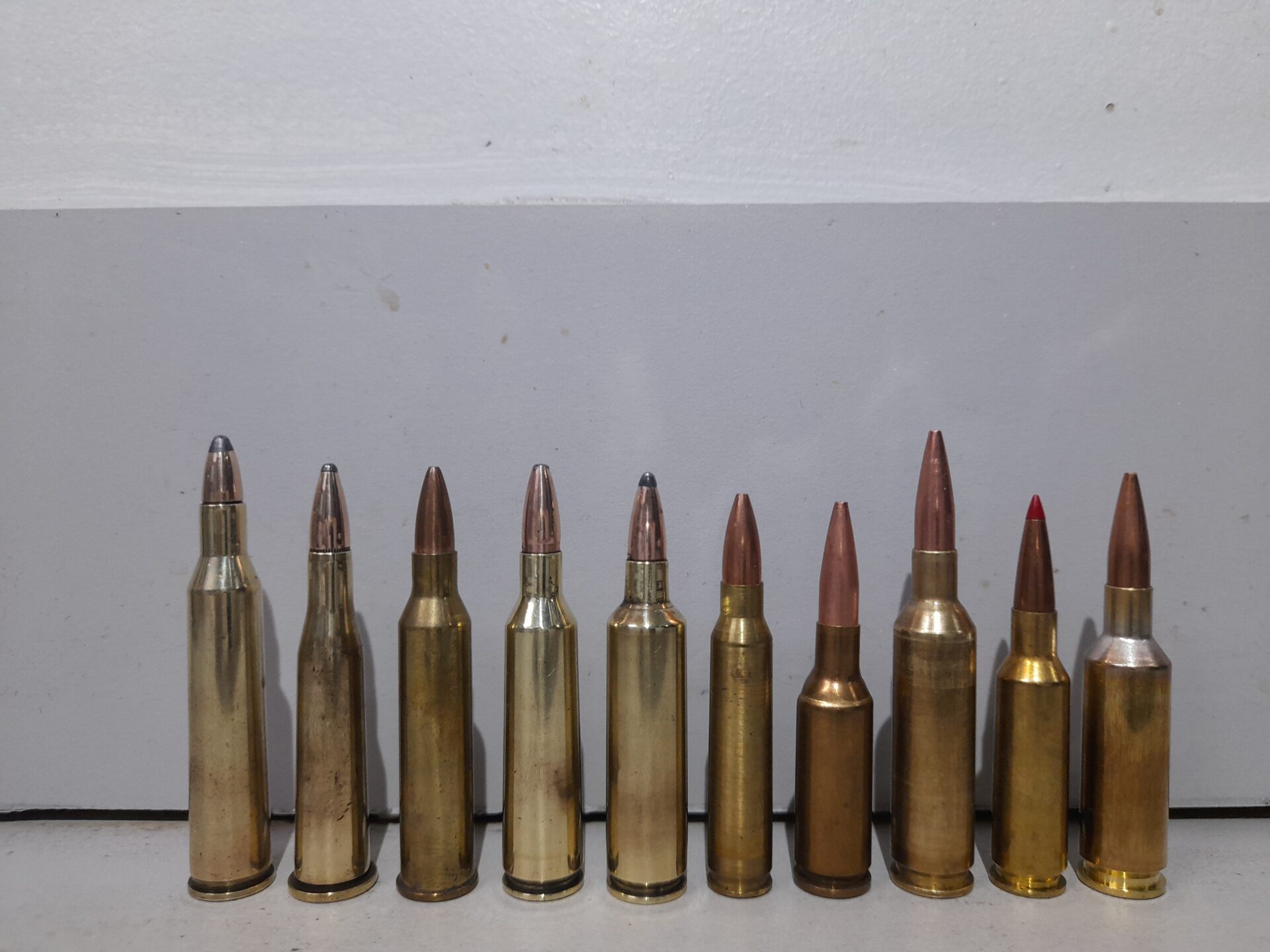
A decade later, in 1974, a significant design change to a short, fat case saw the birth of the .22 PPC. This was formed by shortening .220 Russian brass and blowing out a sharper shoulder. Rifles needed to be custom built until Ruger released it in the M77 varmint model. The .22 PPC was aimed squarely at the benchrest market, and it still has a small but dedicated following due to its renowned accuracy. Forty-grain bullets leave the muzzle just shy of 3,800fps, making this a genuine hot-rod. This case quickly became the darling of the benchrest world, taking out numerous titles and records. Rifles and ammunition for this little cartridge are now extremely hard to find.
We didn’t see the introduction of the next commercial high velocity .224 calibre until 2003 when Winchester released the .223 WSSM (Winchester Super Short Magnum). This extraordinary looking cartridge raised the velocity bar significantly. Factory ammunition loaded with 55gr bullets developed 3,850fps at the muzzle. To compare apples with apples, when loaded with 40gr projectiles, this short, fat round allegedly hit an incredible 4,600fps at the muzzle. Wow! One of the major downfalls of the WSSM family was barrel life; they were renowned for throat erosion. It wasn’t long before the lack of rifles and ammunition for the WSSM group of cartridges saw them fade from the scene.
Following the extraordinary success of the 6.5 Creedmoor (the cartridge loved and hated by millions), then the 6mm Creedmoor, a necked down .22cal version was commercially released in 2014. Naturally dubbed the .22 Creedmoor, this cartridge pushes 55gr projectiles across the chronograph at speeds knocking on the door of 4,000fps. I don’t have first-hand data for lighter bullets but exceeding 4,300 would be expected. As popular as this screamer is in the United States, it really hasn’t taken off in a big way here in the antipodes (Aus/NZ). There are more rifles chambered for it becoming available in Australia each year and factory ammunition is now starting to come in through major US manufacturers. Like the .223 WSSM, case capacity is how such high speeds are generated. These modern ‘fast’ cartridges experience the same drawbacks as those of previous eras: limited barrel life.
January 2017 saw Nosler introduce its .22 Nosler to the shooting community. Like the majority of newer .224cal’ cartridges, the .22 Nosler was designed to fit into a standard AR15 firearm. That’s great if you live in the United States but largely irrelevant for our domestic market. In an uncommon design, the .22 Nosler has a rebated rim, where the body of the case is a greater diameter than the rim. Appearance-wise, the case of the .22 Nosler is very similar in dimensions and taper to the 6.8 SPC. The rebated rim allows a standard .223 bolt face to be used. Despite its slightly increased case capacity, the .22 Nosler only gives slight improvements in muzzle velocity over the .223 Remington, usually 100 to 150fps. Like most Nosler cartridges, rifles and ammunition are quite rare.
During that same year, Federal launched its entry into the small-bore speed stakes with the .224 Valkyrie. This case is the 6.8 SPC necked down to .224 but without recessing the case head, as was done by Nosler. Hence, it uses a bolt face in between the common sizes of .384” (.223 etc) and .473” (.308, etc). The Valkyrie and its parent case require a bolt face of .427”, which is unique to those cartridges. This differs from bolts using the same head size (.445”) as the 7.62×39 Russian, .22 PPC and the more recent ARC series (to be discussed further on). Bolts from .223 rifles can be opened up to accept the Valkyrie head but will still have the narrow .223 extractor claw. Performance-wise, the Valkyrie (designed to send heavy calibre bullets out to long ranges) launches lighter 55gr loads in excess of 3,300fps. Its forte, long, high BC bullets, like the Rexem 80gr hollow point, exit the muzzle just shy of 3,000fps. The Valkyrie remains a niche calibre in Australia with no factory rifles currently available and very limited ammunition options. However, for the reloader, dies are readily sourced if you can find brass. They need to have a custom barrel made, then reloading is not a handicap for many dedicated shooters. That hard-to-find brass which can’t be formed from any readily available options could be a showstopper.
The year 2022 saw another wildcat cartridge become mainstream in the 22GT. This is simply the 6mm GT necked down to .224 calibre. Like its parent case, the 22GT shoots long, high BC bullets, enabling long range targets to be effectively engaged. Aimed at competition shooters, the 22GT quickly found favour among hunters. Long shots at coyotes in its home country along with foxes, wild dogs, medium pigs and fallow deer here in the antipodes are the strength of the GT. Mild recoil and inherent accuracy along with great efficiency for the limited powder capacity are among the desirable features of this cartridge. Cases can be made from commonly available .22-250 brass with a little patience and a forming die.
The most recent (2024) of the .22-calibre offerings to make headlines is the .22 ARC (Advanced Rifle Cartridge), another offering from Hornady. Similar to many other small-bore cartridges, this is a larger case simply necked down to the smaller diameter. In this case the parent is the 6.5 Grendel, which was first necked down to become the 6mm ARC before making the step down to .22. The main drawback of the .22ARC is its use of the .441” bolt face of the 7.62×39 Russian. This limits the ability to use existing rifles in more popular cartridges for donors to be re-barrelled to suit the .22ARC. Performance of the ARC sits a little below that of the 22GT due entirely to case volume. Both are very efficient case designs. As is the situation with many new cartridges coming from the US, the ARC’s popularity on its home turf can be attributed to it fitting in an AR platform. It was purposely designed for use in AR style self-loading rifles. Bolt action rifles are trickling onto the market and are slowly becoming available in Australia. Interest here is almost entirely due to clever marketing by Hornady and the popularity of videos streaming on various sharing platforms. If it is popular in the US, we here are bombarded with videos from ‘GunTubers’.
Throughout the course of my shooting career, spanning close to half a century, I’ve owned and shot with quite a few of the speedy .22cal’ cartridges mentioned. The fastest of them all was my old .22-250 Ackley improved, not listed before because it is a wildcat; therefore, no factory ammunition nor rifles have been marketed for it. Similarly, the old .218 Mashburn and the more modern .223 Ackley and the .22 Middlestead can’t make the list despite their performance. Brass for these wildcat cartridges needs to be formed from other commercial cartridge cases, then often fire formed in the chamber to obtain the finished item.
My choice
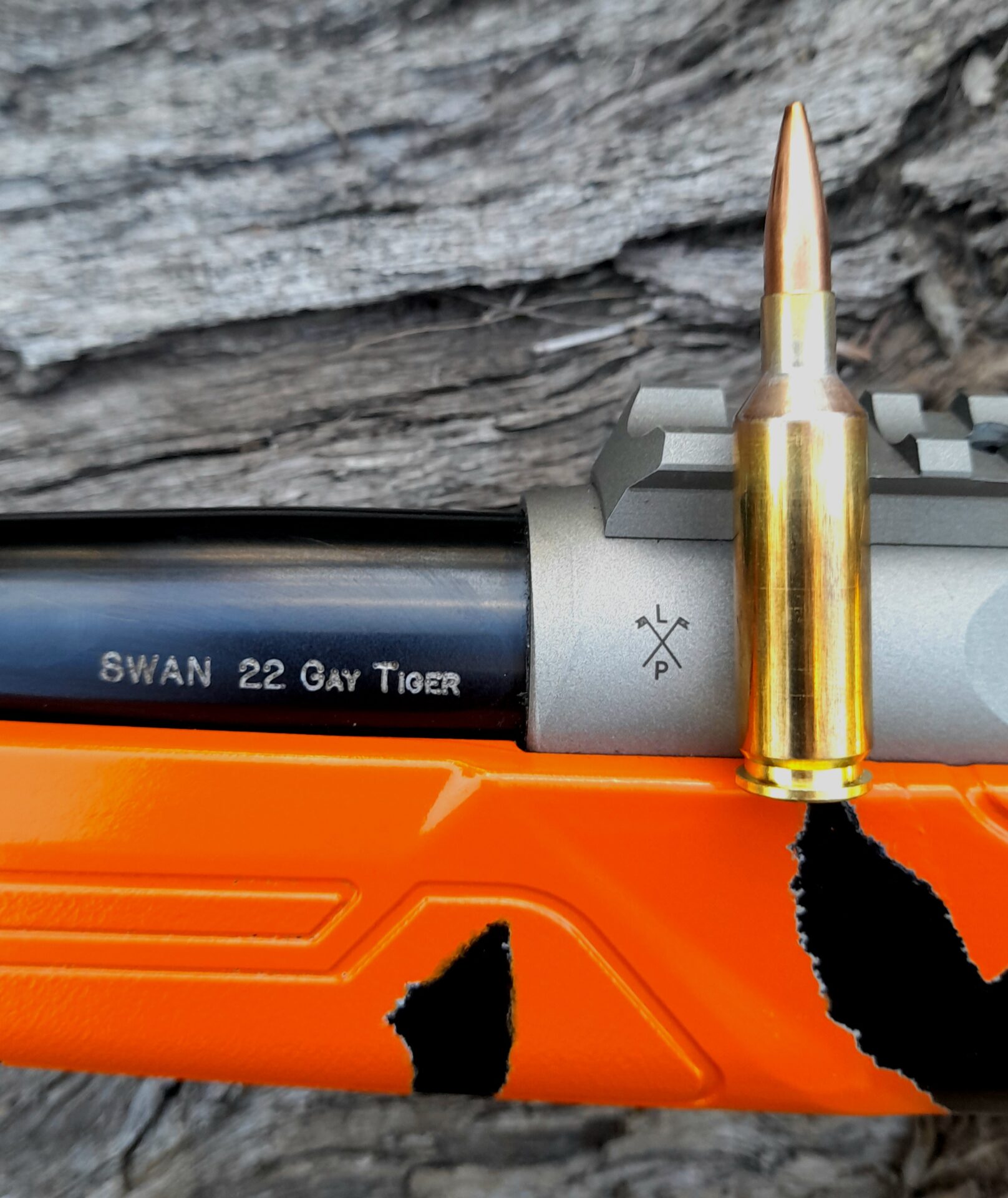
My current high-performance .224 rifle is a Lithgow LA102 action that wears an aftermarket Swan barrel. After much research and deliberation, I opted for the 22GT for several reasons. First, I could source both factory brass and dies for it locally. Many cartridges, both old and new, that look very useful when reviews from overseas are studied, remain impossible to source in Australia. The 22GT required a custom barrel to be made, but, as the reamer was already in the catalogue list of my local barrel maker, that was easily arranged. Dies were quite easily sourced after a quick search online. I purchased a full die set but could have just gone with a single full-length 22GT sizing die, then used my universal seating die for bullet seating. Brass came from a store in South Australia, sourced after a hot tip from a friend. Sitting between the .22 Creedmoor and the .22ARC in case capacity, it provides good barrel life and excellent exterior ballistics. Powder charges are quite miserly. I’m loading just 35gr of powder under 80gr Rexem hollow-point projectiles to deliver 3,200fps over the chronograph. Brass life has been excellent thus far, helped by the 35-degree shoulder, which not only decreases case stretch but also maximises the case’s powder capacity. Recoil is very tame, about 6ftlbs in a lightweight hunting rifle.
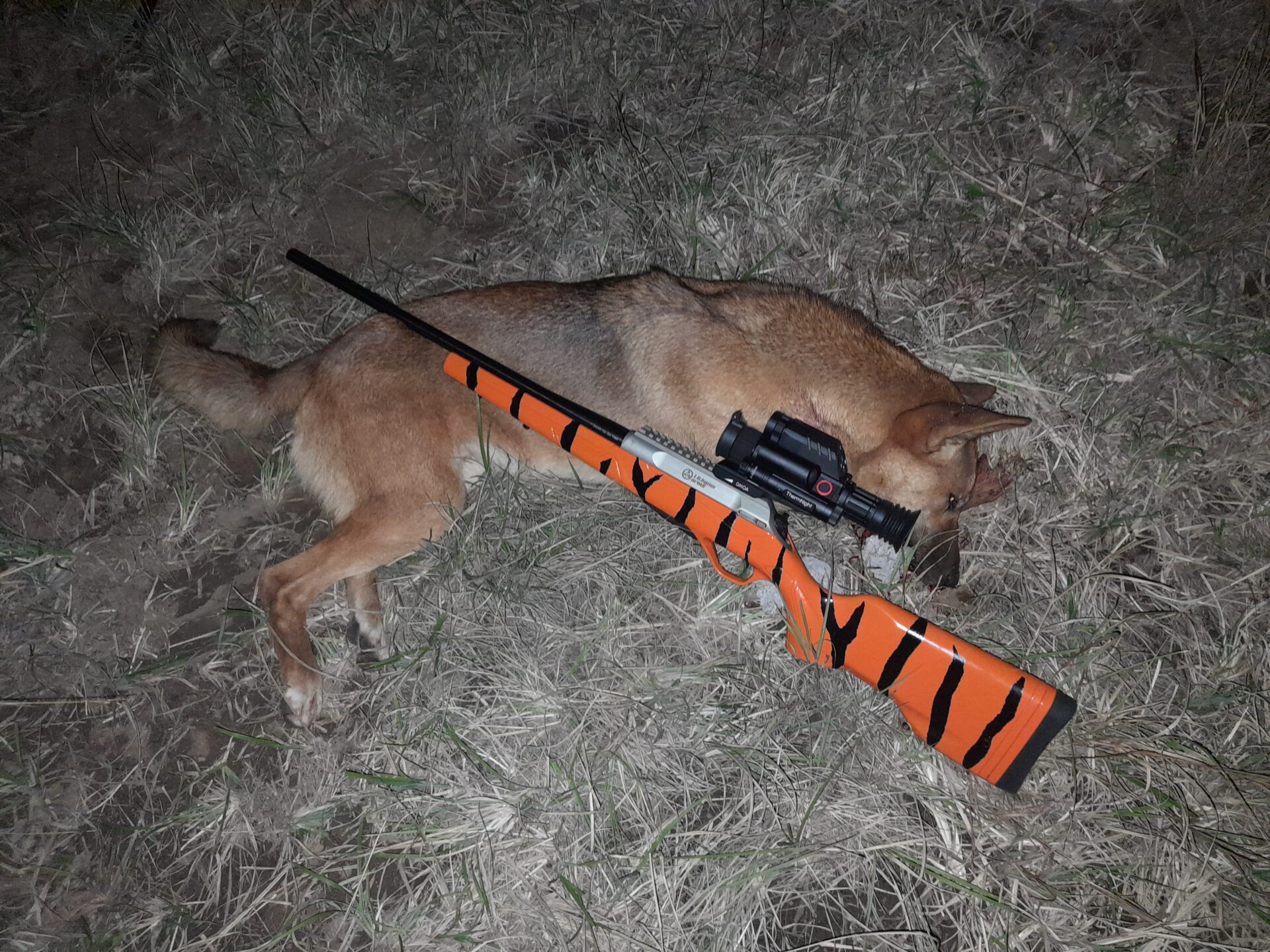
Accuracy of the 22GT is on par with most modern cartridges. Shooting over the tray of my ute in field conditions, my rifle is regularly delivering half MOA or better five-shot groups at 100m. Shooting prone at 300m, putting all the shots into a 50mm circle is common if I don’t introduce too much ‘operator error’. Ease of handloading for the GT is one of its attributes. This cartridge is not fussy when it comes to powder choice or seating depths. I simply load to magazine length and then forget that my seating die is adjustable. There is ample room in the short, fat GT case for more powder, but I’m loading about 1.1 grains under maximum listed charge for the projectiles and am happy with both the velocity and accuracy being achieved.
A little shooter humour
When the parent cartridge, the 6mm GT began generating interest in competition circles in the US, questions were asked where the name originated. This was in the era of the Tiger King television program. Some clever person commented on a forum that GT stood for Gay Tiger. Well, didn’t the forums light up! The gag was so well received that Alfa Munitions has done a few limited production runs of brass head stamped, ‘6mm Gay Tiger’. A very strong following of ‘Gay Tiger’ fans soon developed, with team shirts printed for competitions, etc. Some shooters have had their alloy chassis anodised in rainbow hues and have rifle cases, etc adorned with Gay Tiger stickers. I decided to join in, and my rifle is engraved with .22 Gay Tiger, as the calibre on the barrel. My GT now wears a hand painted stock, and I’ve also had a tiger stripe gun bag made. Themed shirts are also a part of my shooting wardrobe.
Hunting
Like 80 per cent of rifle shooters in Queensland, I am a hunter. I rarely visit a formal range and prior to January this year, I had never shot a rifle competition. My primary motivations for shooting are feral animal management and putting meat on the table, in that order. Although George Gardner and Tom Jacobs designed the GT cartridges for the competition market, they are highly capable hunting rounds. A mature fallow doe was the first animal harvested with my 22GT. Instant lights-out was delivered via the 80gr Rexem hollow point bullet through the shoulder into the vitals. She was deceased before the echoes of the shot had rebounded from the surrounding hillsides. Since that first outing, my 22GT has had the stock swapped for one I hand painted but is still regularly in my hands on walks in the mountains. Its tally of fallow deer has reached double figures, all of which were DRT (dead right there). Feral pigs, too, have fallen victim to the GT’s inherent accuracy, along with an impressive tally of foxes, several wild dogs and one lone feral cat.
I can almost hear the nay sayers going into meltdown, “You can’t hunt deer with .22 cal rifles.” Firstly, in Queensland, there is no calibre restriction for hunting deer. Secondly, fallow deer are small, lightly built animals, easily terminated humanely with moderate energy centre-fire cartridges. If you are doubting the wisdom of using a .224 calibre bullet for fallow deer, consider this: from the 22GT, those 80gr projectiles are delivering more than 1,600ftlbs of energy at 200m. That is more than enough to anchor any mid-sized game animal in its tracks with a shoulder shot. Compare that to a .243 with a 90gr bullet that is delivering around 1,400ftlbs at the same range. The difference in diameter from the 5.56mm .224 calibre to the 6mm .243 calibre is 0.44 millimetres. The animals can’t pick the difference. It is usual for a shoulder shot on fallow with the 22GT to put the bullet through the entire chest area to lodge in the hide on the opposite side. That’s a perfect energy transfer and the effect is instant lights out.
