

Marlin 1894 in .357 Magnum
By Billy Allen
The rifle in this review is the Marlin 1894 chambered in .357 Magnum provided by NIOA Australia. This specific example is from the modern production era, after Ruger acquired Marlin in late 2020. Ruger secured the intellectual property, tooling and designs – exclusive to Marlin – and has since focused on reviving the line with improved manufacturing standards and quality control at its facilities. Under Ruger, Marlin has thrived, potentially making it the leading lever-action rifle manufacturer in the industry.
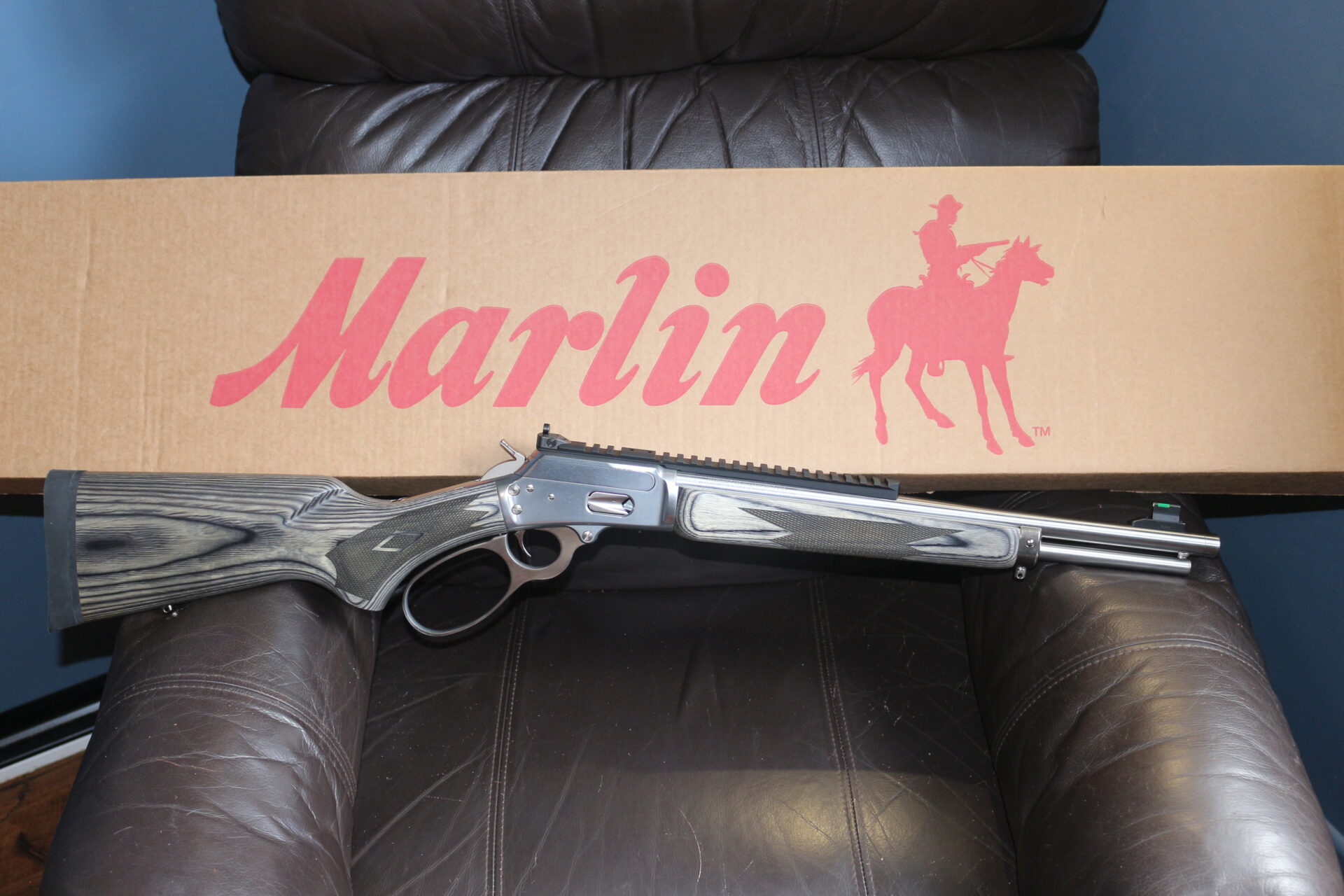
NIOA offers the 1894 Marlin in six configurations to suit various preferences across the Australian market, including: the classic blued timber 1894 with a straight grip; a guide gun in laminated stock with traditional styling; a trapper variant with skinner sights; a dark series with M-LOK slots and tactical features; and the one supplied for testing – a stainless laminated stock with pistol grip, ghost ring sights and full-length Picatinny rail. This range ensures there’s an 1894 for every shooter, from purists to those seeking modern enhancements.
I picked up the new 1894 Marlin, and as soon as I took it from the counter in the shop, it felt immediately right. It balanced perfectly in my hands – carrying some welcome heft with a solid feel for such a compact rifle. Right then, the rifle gave every impression of being built for real use in the field, maneuverable and genuinely enjoyable to handle.
From that very first moment, I sensed this might be one of those test pieces that would be difficult to hand back at the end of the review. It carried like something designed with the Australian bush in mind – compact, well-proportioned and ready for whatever came next.
What follows is a straightforward account of how it performed.
First impressions
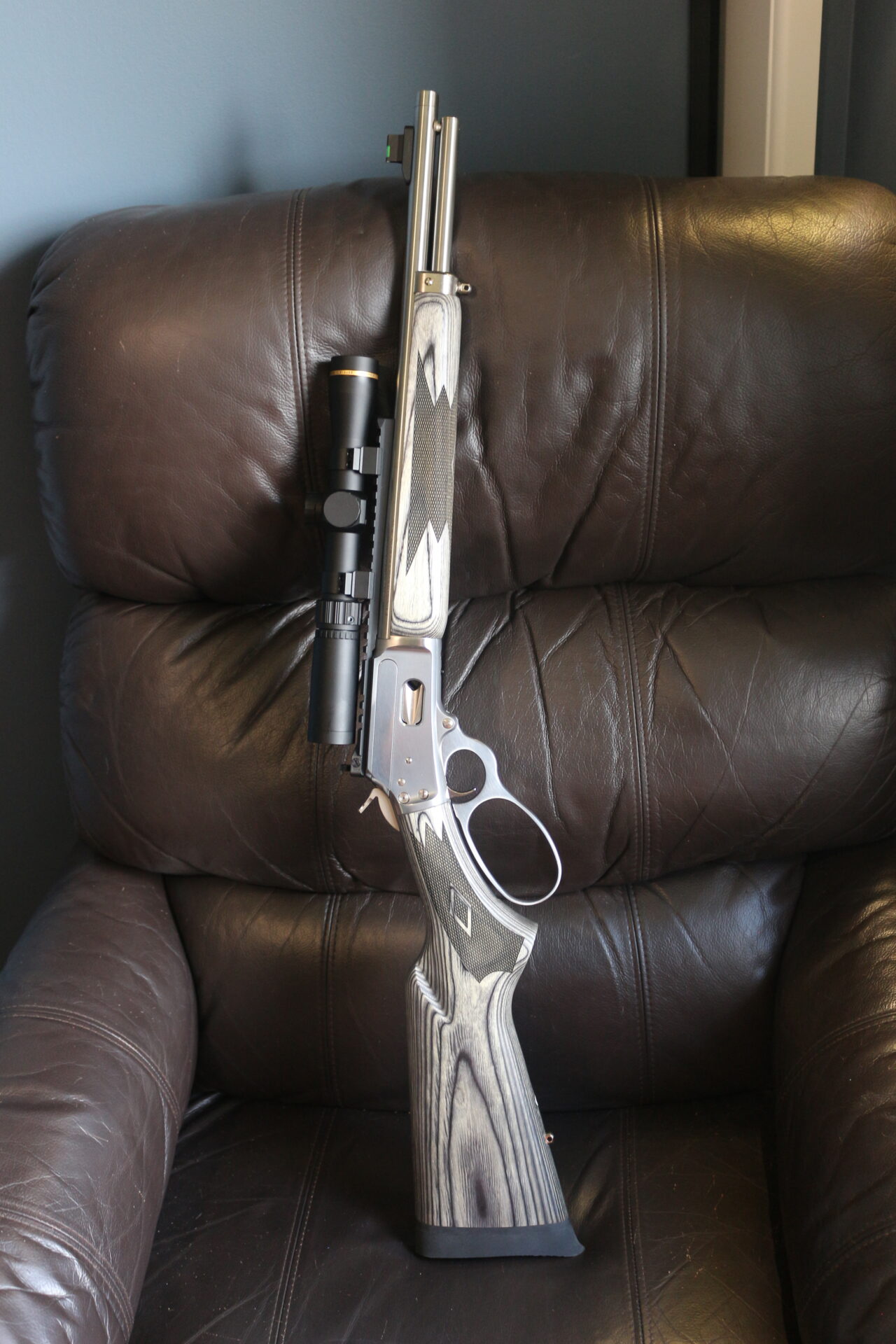
Unboxing the Marlin 1894 was like stepping into a piece of firearms’ history, but with a contemporary twist. When the rifle arrived, I was immediately struck by its compact design. At just 86cm overall length and with the bare rifle weighing just under 3kgs, it felt balanced and ready for action. Expertly assembled, the stainless-steel barrel, receiver, lever, and trigger guard are the products of precision CNC machining, demonstrating quality craftsmanship.
With a classy look, the grey laminated stock immediately stood out. The laser-cut checkering was well-executed, offering a secure grip on the pistol grip and fore end. The checkered panels on the pistol grip and forend provide a secure hold, even in humid Queensland conditions. Quick-detachable sling swivel studs were a thoughtful addition, making it easy to attach a carry sling for long days afield. The soft rubber buttpad promised to tame any recoil, and the fibre optic ghost ring sights, paired with a full-length Picatinny rail, hinted at versatility – whether you prefer iron sights or mounting a scope.
The 1894 exuded a sense of purpose, like a tool designed for use rather than show. Overall, my initial encounter left me eager to take it to the range and see how it performed beyond the workbench.
Technical specs and data
Diving deeper into the Marlin 1894’s build, it’s clear this rifle is engineered for reliability and performance. Chambered in .357 Magnum, it offers a calibre that’s versatile for both recreational shooting and hunting within ethical ranges. The barrel measures 16 inches, crafted from stainless steel via cold hammer forging – a process known for enhancing durability and accuracy. It’s threaded at the muzzle, opening up options for muzzle devices.
The receiver, lever and trigger guard plate are all stainless steel, machined with CNC precision for smooth operation. The tubular magazine holds eight rounds, fed through a side-loading gate that’s functional, though it requires a bit of practice. The trigger pull averaged around six pounds – crisp enough for deliberate shots without being overly heavy.
The fibre optic ghost ring sights are adjustable: lateral windage shifts easily with a small flat blade screwdriver, while elevation requires loosening a set screw and rotating the aperture up or down. Intuitive and user-friendly, this system reminds me of the XS ghost sight rail on my own Marlin 336. The full-length Picatinny rail accommodates optics seamlessly, making it adaptable for different shooting styles.
In terms of dimensions, the rifle’s short stature and light weight make it ideal for confined spaces, but it’s built to last. The laminated stock and stainless barrel and action make this rifle impervious to water, opening up use in all weather conditions. The overall construction reflects high standards of quality control. Priced around $2600, it’s positioned at the higher end of the lever action rifle market, but the investment promises rugged and reliable longevity – potentially spanning a lifetime.
In the field
Taking the Marlin 1894 out for testing was where it truly came alive, transforming from a beautiful-looking rifle into a dynamic shooting companion. I took the 1894 shooting on my family farm and initially mounted my Leupold Scout scope onto the Picatinny rail to get an idea of the rifle’s accuracy. At 50 yards on 4x power, the first two groups were MOA – tight clusters that showcased the rifle’s inherent accuracy potential. The short barrel and compact design made it effortless to handle, with minimal recoil allowing me to spot impacts and acquire follow-up targets quickly.
Switching to the open sights, you can easily find the sizable front bead when you shoulder the rifle. If you aim at the 50-yard mark, the bead will cover the vitals of a regular-sized pig, so you would need to hold the bead over the lower half of a pig’s vitals, with the rifle sighted in to hit just the top of the bead. Familiarity bred proficiency; by 25 shots, I was consistently able to ring an eight-inch Bisalloy gong offhand at the 50-yard mark. The ghost ring setup proved effective out to around 100 yards, where the .357 Magnum’s trajectory arcs noticeably, limiting longer-range precision without optics.
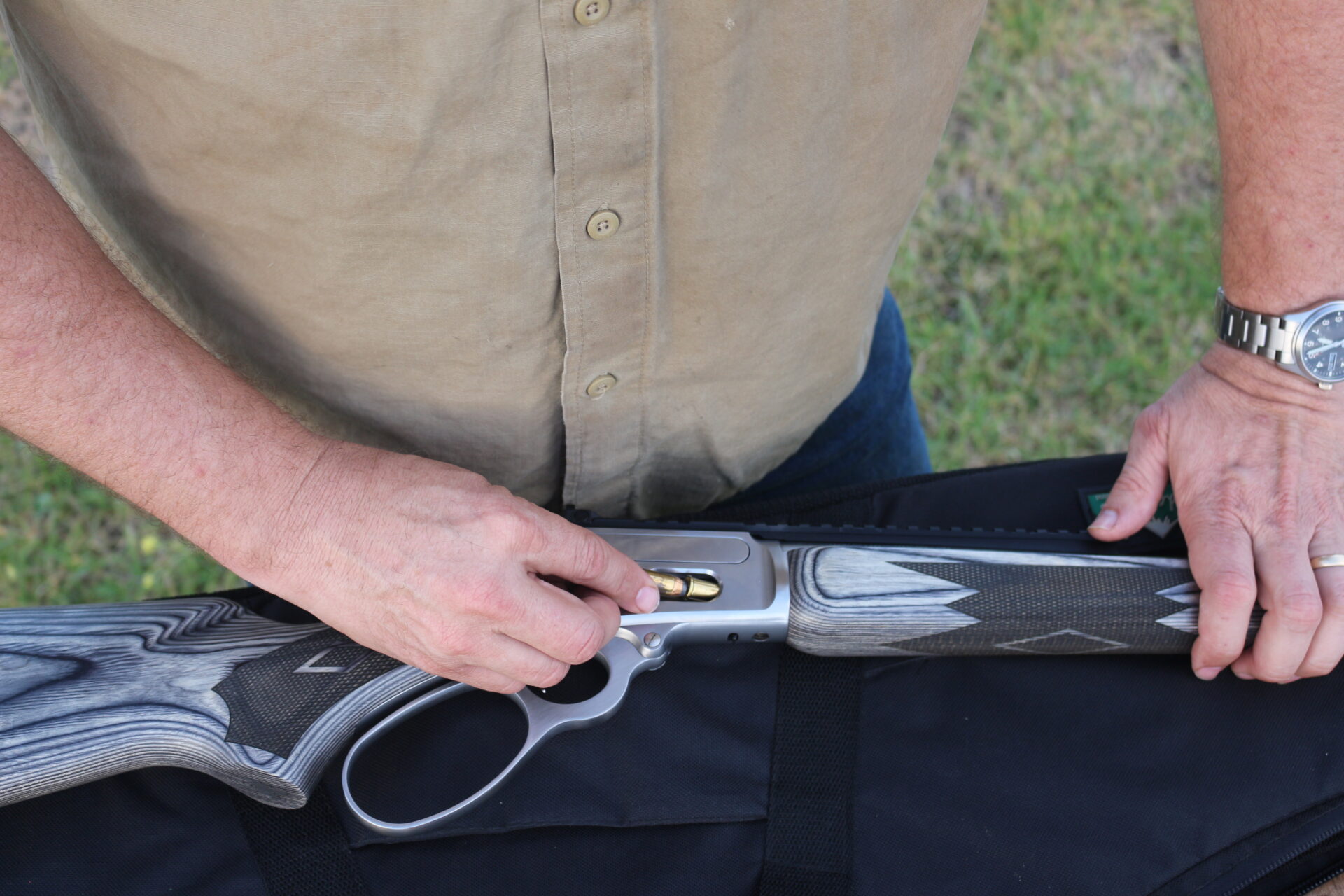
The side loading gate was smooth, and because the spring wasn’t overtight on the loading gate, the tubular magazine loaded with ease. The best way to load through a gate, I’ve found, is to partly insert a round, then use the following bullet to finish pushing it in, leaving the gate ready for the next. Using the loading gate is a convenient means to load a tubular magazine, but it’s not a rapid loading system and requires pausing to reload once the eight-round capacity is depleted.
The rifle’s maneuverability shone in practical scenarios. Its compact size made it easy to stow in a vehicle without awkwardness, and I could envision it perched on a quad bike’s front rack with no overhang. In thick scrub or confined bush, where space is at a premium, the 1894 would excel, requiring minimal room to shoulder and fire.
Operationally, the lever was slick from the outset, as if already broken in. The stroke was just right – neither too long to cause short-stroking nor cumbersome. I fired just over 100 rounds in my testing, and I can report that there were zero failures to feed, eject or fire; reliability was flawless. The lever’s width and rounded edges prevented any discomfort to my knuckles or hand during cycling.
Recoil was negligible, aiding in maintaining the sight picture for successive shots. With eight rounds on tap, it’s sufficient for scenarios like shooting multiple pigs on the move, where quick cycling and staying on target prove beneficial. Yet, once empty, reloading the tubular magazine demands effort and time, meaning the shooter will need to stop and insert cartridges individually via the loading gate. This self-limiting aspect curtails extended bursts, promoting strategic use. I find topping off the magazine incrementally after shots is the best approach, ensuring that the tubular magazine never empties completely.
The cross-bolt safety proved useful during unloading; it prevents the hammer from being able to strike the firing pin when emptying the tube magazine. This process means a live round is chambered with the hammer cocked, but I feel secure in this process utilising the added protection given by the cross-bolt safety. However, I prefer to carry a lever action in the field with the hammer set at half-cock without using the cross-bolt safety.
By the time I had fired 50 rounds, I was sold; the 1894 was quick, accurate and fun to shoot. It handled like a natural extension, proving its worth in varied field conditions.
Final thoughts
Wrapping up my time with the Marlin 1894, it’s hard not to rave about its charms. This is a fantastic plinking rifle – fun, easy to manipulate and chambered in .357 Magnum, where ammunition remains reasonably affordable compared to other pistol-calibre options. Within 100 yards, it delivers solid stopping power on pig-sized game, making it economical and effective for hunters.
Its short, handy profile excels in tight spots: vehicles, quad bikes, or navigating dense scrub. Reliability was absolute across all functions, with excellent scoped accuracy and dependable open-sight performance once acclimated. Manufactured to the highest standards with outstanding quality control, it’s a rifle built to endure.
At around $2600, it’s a premium purchase, but one that justifies the cost through longevity and performance. Returning it after testing was tough – it was handy, great-looking, and perfectly reliable. For shooters and hunters seeking a blend of heritage and practicality, the Marlin 1894 in .357 Magnum is a compelling choice.